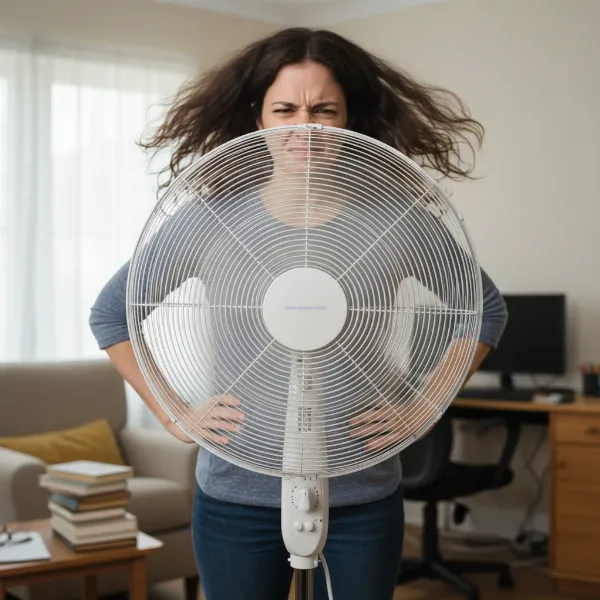
Choosing the right electric fan can significantly impact your comfort and energy bills, especially as temperatures rise. With countless options on the market, from classic ceiling fans to versatile floor models, deciding which fan is truly more efficient for your specific needs can feel overwhelming. Do you prioritize widespread air circulation or focused personal cooling? The answer isn’t always straightforward, as efficiency hinges on several factors beyond just wattage. Let’s delve into the world of electric fans to uncover which type offers the best blend of performance, cost-effectiveness, and comfort for your living space.
Electric Fans: An Overview of Common Types
Electric fans are indispensable household appliances designed to create a cooling sensation by circulating air. While they don’t actually lower the ambient temperature of a room, they make you feel cooler by accelerating the evaporation of sweat from your skin. This evaporative cooling effect can make a room feel several degrees cooler, often allowing you to raise your thermostat setting and save on air conditioning costs.
Historically, the ceiling fan has been a staple, permanently installed overhead to distribute air throughout an entire room. Modern ceiling fans have evolved to include a variety of styles, sizes, and features, often acting as both a light source and a decorative element. They excel at moving large volumes of air, creating a general breeze that impacts everyone in the room.
In contrast, floor fans, which encompass standing fans, pedestal fans, and tower fans, are portable units designed for flexibility. They can be placed directly where cooling is needed, making them excellent for localized airflow. These fans come in various designs, from traditional round-blade models to sleek, space-saving tower fans. Each type serves a distinct purpose, offering unique advantages depending on your cooling requirements.
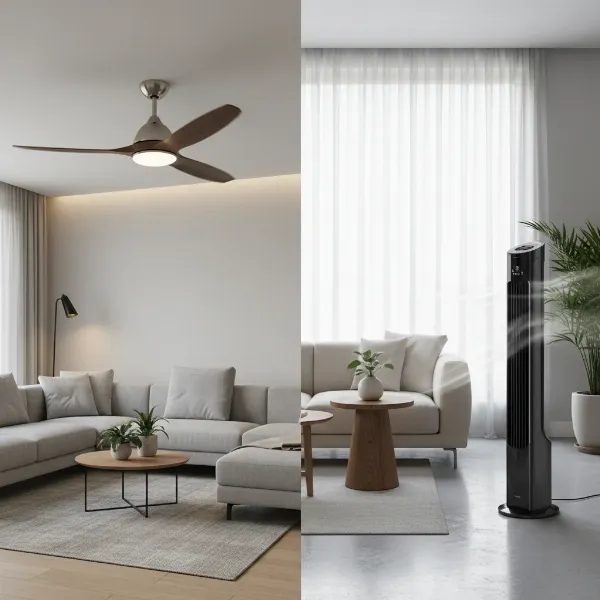 A side-by-side comparison of a ceiling fan and a floor fan in a living room setting.
Guiding Your Choice: Which Fan Suits Your Needs?
Selecting the ideal electric fan requires a thoughtful assessment of your specific environment and preferences. It’s not just about which fan moves the most air; it’s about which fan delivers effective, efficient cooling where and when you need it most.
Assess Your Cooling Requirements
Before making a purchase, take a moment to consider how and where you’ll use your fan.
- Room Size: For expansive living areas, open-plan offices, or large bedrooms, a fan capable of widespread air distribution is crucial. Smaller spaces, such as compact bedrooms, home offices, or reading nooks, might benefit more from a focused airflow.
- Purpose of Use: Are you looking to cool an entire room consistently, or do you need a direct breeze to combat personal heat? Some fans are built for ambient cooling, while others are designed to deliver a powerful, concentrated gust.
- Budget: Consider both the initial purchase price and any potential installation costs. While some fans are plug-and-play, others require professional setup, adding to the overall investment.
|
Our Picks for the Best Electric fan in 2026
As an Amazon Associate I earn from qualifying purchases.
|
||
| Num | Product | Action |
|---|---|---|
| 1 | Dreo Fan for Bedroom, 120° Oscillating Standing Fan, Quiet Floor Fan with DC Motor, Pedestal Fan for Room, 9 Speeds, 4 modes, 20dB, 120° Manual Vertical, 37-42" Adjustable Height, 9H Timer, Black |

|
| 2 | Viniper Portable Rechargeable Fan, Small Desk Fan : 3 Speeds & about 8-24 Hours Longer Working, 180 Rotation, Portable Desktop Fan Small but Mighty, Strong Wind (White, Light Black Blade)6.2 Inch |
|
| 3 | Dreo Tower Fan for Bedroom, 25ft/s Velocity Quiet Floor Fan, 90° Oscillating Fans for Indoors with 4 Speeds, 4 Modes, 8H Timer, Standing Fans, Bladeless Fan, Black, Nomad One (DR-HTF007) |
|
| 4 | LEVOIT Tower Fan for Bedroom, 25ft/s Velocity Standing Fan with 28dB Quiet for Sleep, Remoter, 12H Timer, 5 Speeds, 4 Modes, 90° Oscillation for Home, Office, Indoor, Bladeless 36 inch, White |
|
| 5 | Amazon Basics Air Circulator Fan, Desk Fan for Bedroom, Home and Office, With 90-Degree Tilt Head, 3 Speed Settings, Lightweight (3 LBS), 35 Watts, Black, 11.1"W x 6.3"D x 10.9"H |
|
| 6 | XPOWER FC-100S Multipurpose 11 Pro Air Circulator Utility Fan with Oscillating Feature |
|
| 7 | Lasko 2520 Oscillating Stand Fan,White 16 Inch |
|
| 8 | 10" Modern Standing Fan for Bedroom, Sleek Oscillating Pedestal Fan, 3-Speed & Height Adjustable Compact Floor Fan for Home Office & Dorm |
|
| 9 | Amazon Basics 16" Pedestal Fan with Remote, Floor Fan, Standing Fan for Bedroom, Living Room, Office, with 3 Speeds, 3 Modes, Timer, Dual-Layered Blades, Adjustable Height, Tilt Head, 60W, Black |
|
| 10 | Dreo Fan for Bedroom, 120° Oscillating Standing Fans, Quiet Floor Fan with DC Motor, 100ft Pedestal Fans for Room, 9 Speeds, 4 modes, 20dB, 120° Manual Vertical, 37-42" Adjustable Height, 9H Timer |
|
Key Factors for Selection
When comparing electric fans, several important criteria will guide you toward the most suitable option.
- Power Consumption & Airflow: Look beyond simple wattage. A fan’s efficiency is often measured by its CFM (Cubic Feet per Minute) per watt, indicating how much air it moves relative to the energy it consumes. Newer fans, especially those with DC motors, tend to offer superior energy efficiency.
- Noise Level: A powerful fan can quickly become a nuisance if it generates excessive noise, particularly in bedrooms or quiet workspaces. Many manufacturers provide decibel ratings, allowing you to compare models for silent operation.
- Features: Modern fans come equipped with a range of features that enhance convenience and functionality. These can include remote controls, multiple speed settings, oscillation, natural breeze modes, sleep timers, and even smart home compatibility.
- Brand Reputation & Reliability: Opting for reputable brands often ensures better product quality, longer lifespan, and reliable customer support.
- Energy Savings: Look for certifications like Energy Star, which indicate that a fan meets strict energy efficiency guidelines. Fans with DC motors are particularly noteworthy for their low power consumption and quiet operation, often being three times more efficient than traditional AC motor fans.
Ceiling Fan vs. Floor Fan: A Direct Comparison
Understanding the inherent strengths and weaknesses of each fan type is essential for making an informed decision.
Ceiling Fans are champions of whole-room circulation. They are ideal for maintaining a comfortable ambient temperature across larger spaces. By pushing air downwards in the summer, they create a cooling downdraft. In winter, reversing the blade direction can gently redistribute warm air trapped near the ceiling, helping to optimize heating efficiency. Ceiling fans don’t occupy any floor space, making them an excellent choice for cluttered rooms or homes with small children and pets, as the blades are safely out of reach. While their initial cost and installation can be higher, their longevity and ability to impact a wide area make them a sound long-term investment. They are particularly suitable for rooms with high ceilings where their expansive reach can be fully utilized.
Floor Fans (including pedestal and tower fans) offer unparalleled flexibility and portability. They are perfect for targeted cooling, allowing you to direct a concentrated stream of air exactly where you need it, whether you’re working at a desk, relaxing on a couch, or sleeping. This targeted approach can be more energy-efficient for individual use or small areas since you’re not trying to cool an entire room. Floor fans typically have a lower upfront cost and require no installation, making them a budget-friendly and renter-friendly option. However, they do occupy floor space and can pose a tripping hazard or be accessible to curious children and pets. For rooms with low ceilings where a ceiling fan might feel intrusive or impractical, a floor fan is often the best alternative.
Detailed Comparison: Ceiling Fan vs. Floor Fan
Let’s break down the key differences to help you decide which fan aligns best with your cooling strategy.
| Category | Ceiling Fan | Floor Fan (Pedestal/Tower) |
|---|---|---|
| Efficiency | Generally good for whole-room circulation. Modern DC motor fans are highly energy-efficient (e.g., 20-50W). Can lower felt temperature by up to 4°C. Larger models can use more power (60-100+W) if not optimized. | Excellent for targeted, localized cooling. Often uses less electricity for personal cooling (30-75W average), but may require multiple units for large areas, increasing overall energy use. Small standing fans (28.5W) can be very efficient for individual use, while medium-sized standing fans might consume more (52.7W average) than many ceiling fans. |
| Cost | Higher initial purchase price ($100-$500+) plus professional installation ($100-$200+). | Lower initial purchase price ($30-$300), no installation costs. |
| Installation | Fixed, permanent installation, often requires professional wiring. | Portable, plug-and-play, no installation needed. |
| Portability | None. Once installed, it stays put. | High. Easily moved from room to room or repositioned within a space. |
| Coverage | Wide, ambient air circulation throughout the entire room, effective for larger spaces. | Targeted, directional airflow, best for personal cooling or small zones. May struggle to cool large rooms effectively with a single unit. |
| Noise Level | Generally quieter, especially on lower settings; modern DC motor fans are particularly silent. Can provide a gentle hum. | Can range from moderate to high, particularly for powerful models. Some tower fans are designed for quiet operation. Large, slow rotary fans can optimize noise-to-effectiveness. |
| Safety | High. Blades are out of reach, making them safer for homes with children and and pets. | Moderate. Takes up floor space, potential tripping hazard, blades are accessible to children/pets. |
| Durability | Often more robust and designed for long-term use; many last for many years. New DC motors enhance lifespan by eliminating common failure points. | Varies greatly by quality; generally less durable than fixed ceiling units, though high-quality models can last. |
| Aesthetics | Can be a significant design element, enhancing room decor. | More functional in design, though many sleek tower fans offer modern aesthetics. |
| Space Occupied | None (overhead). | Occupies floor space, which can be a consideration in smaller rooms. |
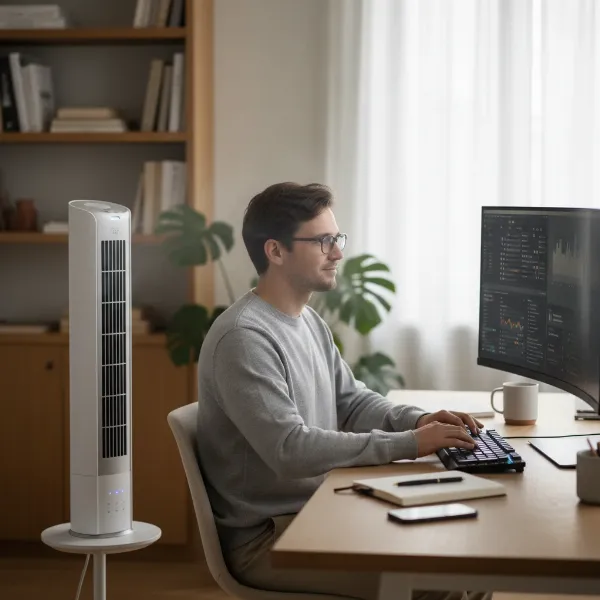 A person working at a desk with a sleek tower fan providing targeted personal cooling.
Tips for Optimal Fan Use and Maintenance
Regardless of your choice, proper usage and routine maintenance can significantly extend the lifespan of your electric fan and ensure it operates at peak efficiency.
Proper Cleaning and Care
Regular cleaning is vital for maintaining airflow and preventing dust buildup, which can hinder performance and even pose a fire hazard.
- Frequency: Aim to clean your fan blades and grilles monthly during periods of heavy use, and at least quarterly otherwise.
- Tools: You’ll typically need a soft cloth, mild soap, a vacuum cleaner with a brush attachment, and possibly a screwdriver for disassembly.
- Steps: Always unplug the fan before cleaning. For floor fans, remove the grille (if possible) and wipe the blades and housing. Vacuum dust from motor vents. For ceiling fans, carefully wipe down the blades, motor housing, and light kit. Avoid spraying water directly onto electrical components.
Safe and Effective Operation
How you operate your fan can impact its efficiency and your comfort.
- Strategic Placement: Position floor fans to create a cross-breeze or to directly target occupants. Ceiling fans should be centered in the room for optimal air distribution.
- Adjust Speed: Use the lowest effective speed setting. Higher speeds consume more electricity and often generate more noise without a proportionally greater cooling effect.
- Avoid Continuous Use: While fans are energy-efficient, running them unnecessarily wastes power. Turn off fans when leaving a room or when no one is present to benefit from the airflow. Fans cool people, not rooms.
Extending Fan Lifespan
A little proactive care can save you from premature replacements.
- Inspect Components: Periodically check for loose screws, wobbling blades, or unusual noises. Tighten any fasteners and address issues promptly.
- Lubrication: Some older fan models may require occasional lubrication of the motor bearings. Consult your owner’s manual for specific instructions, but most modern fans have sealed, maintenance-free bearings.
- Proper Storage: If storing a portable fan for the off-season, clean it thoroughly and cover it to prevent dust accumulation. Store it in a dry, safe place away from extreme temperatures.
Where to Purchase Your Next Electric Fan?
Finding a reliable vendor is just as important as choosing the right fan.
You can find electric fans at various retailers, including large electronics stores, home improvement centers, and a multitude of online marketplaces. When shopping, always:
- Inspect the Product: If buying in-store, check for any visible damage or defects. For online purchases, read recent reviews carefully.
- Verify Warranty: Ensure the fan comes with a manufacturer’s warranty that covers parts and labor for a reasonable period, typically one to five years.
- Consider Return Policy: Familiarize yourself with the retailer’s return policy in case the fan doesn’t meet your expectations.
Your Buying Guide: Making the Right Investment
Making the final decision boils down to balancing your needs with the fan’s capabilities.
What’s Your Budget?
If cost is a primary concern, floor fans offer a lower entry point with no installation fees. However, factor in the long-term energy costs and potential for multiple units if you need to cool a larger area. For a permanent, whole-room solution, a ceiling fan might represent a better long-term value despite the higher upfront cost.
How Big is Your Space?
For large, open spaces, a ceiling fan provides superior overall air circulation. For smaller, more confined areas, or if you only need personal cooling, a portable floor fan is often the more practical and efficient choice. Consider the ceiling height as well; low ceilings might not accommodate a ceiling fan comfortably or safely.
Which Features Do You Prioritize?
If portability, targeted cooling, and quick setup are paramount, a floor fan is your best bet. If you value aesthetic integration, widespread, consistent airflow, safety from children/pets, and don’t want a fan cluttering your floor space, a ceiling fan is likely the ideal solution. Look for modern features like DC motors and smart controls for enhanced efficiency and convenience in either type.
Conclusion
The debate between ceiling fans and floor fans isn’t about one being universally “better” or “more efficient,” but rather about which option aligns best with your unique cooling demands and living environment. While floor fans offer targeted, portable cooling at a lower initial cost, ceiling fans provide superior whole-room air circulation and can be a more elegant, long-term solution, especially with energy-efficient DC motors. By considering factors like room size, desired airflow, budget, and safety, you can confidently select the electric fan that will keep you cool and comfortable without unnecessarily driving up your energy consumption. Which fan will empower your ideal comfort zone?
Frequently Asked Questions
Are DC motor ceiling fans more efficient?
Yes, ceiling fans equipped with DC (Direct Current) motors are significantly more energy-efficient than those with traditional AC (Alternating Current) motors. They consume less power, operate more quietly, and often offer a wider range of speed settings, making them an excellent choice for maximizing energy savings and comfort.
Can I use both a ceiling fan and a floor fan?
Absolutely! Using both a ceiling fan and a floor fan can create a highly effective cross-breeze and enhance overall air circulation. This combination can lead to a more profound cooling sensation, allowing you to potentially raise your thermostat even higher and save more on air conditioning costs.
Which type of fan is best for bedrooms?
For bedrooms, both types have merits. A ceiling fan provides quiet, ambient air circulation that can be ideal for sleeping, as it doesn’t take up floor space. However, a quiet tower or pedestal fan can offer targeted cooling directly at your bed, which some people prefer for personalized comfort. The best choice depends on your room size, ceiling height, and personal preference for airflow.
Do floor fans actually cool a room?
Floor fans, like all standard fans, do not actually lower the ambient temperature of a room. Instead, they create a cooling effect by moving air across your skin, which helps to evaporate sweat and make you feel cooler. For rooms to genuinely cool down, you would need an air conditioner or a whole-house fan that vents hot air outside.