Have you ever walked into a room and felt the air was stale, stuffy, or just not moving? Whether it’s a humid bathroom, a busy kitchen, or a workshop filled with dust, proper ventilation is crucial for comfort, health, and even equipment longevity. At the heart of effective ventilation lies a key metric: Cubic Feet per Minute, or CFM. Understanding how to calculate the right CFM for your space is the first step in selecting the perfect fan. This comprehensive guide will demystify CFM, walk you through the calculation process, and help you choose a fan that delivers precisely the airflow you need.
Understanding CFM: Overview and Common Fan Types
CFM, or Cubic Feet per Minute, is a standard measurement used to quantify the volume of air a fan or ventilation system moves in one minute. Essentially, a higher CFM rating indicates that a fan can move more air. This metric is fundamental in HVAC (Heating, Ventilation, and Air Conditioning) systems, as it directly impacts air quality, temperature regulation, and overall system efficiency. Getting the CFM right means ensuring fresh air circulation, removing pollutants, controlling humidity, and preventing heat buildup.
Fans are essential tools for managing airflow, and their designs vary widely based on their intended application and how they achieve their CFM ratings. Common types include:
- Exhaust Fans: Often found in bathrooms and kitchens, these are designed to remove stale air, odors, and moisture directly from a specific area, expelling it outside. Their CFM is critical for effective pollutant removal.
- Ceiling Fans: Primarily used for air circulation within a room, creating a wind-chill effect that makes occupants feel cooler. While they don’t exchange air with the outside, their CFM indicates their ability to move air volume.
- Whole-House Fans: Typically installed in attics, these powerful fans draw cool air in through open windows and exhaust hot air out through the attic vents, effectively cooling an entire home. They require high CFM.
- Inline Duct Fans: Used within ductwork to boost airflow or exhaust air from multiple rooms, crucial in more complex ventilation systems where static pressure is a factor.
- Portable Fans: Ranging from desk fans to large drum fans, these offer flexible air circulation for immediate cooling or to aid in drying. Their CFM helps gauge their effectiveness in different settings.
- Bladeless Fans: Modern designs that draw in air and amplify it, offering smooth, consistent airflow without visible blades. Their design often focuses on efficient air projection alongside CFM.
Each fan type serves a distinct purpose, and its effectiveness hinges on its ability to deliver an appropriate CFM for its intended use, whether for direct exhaust, general circulation, or comprehensive air exchange.
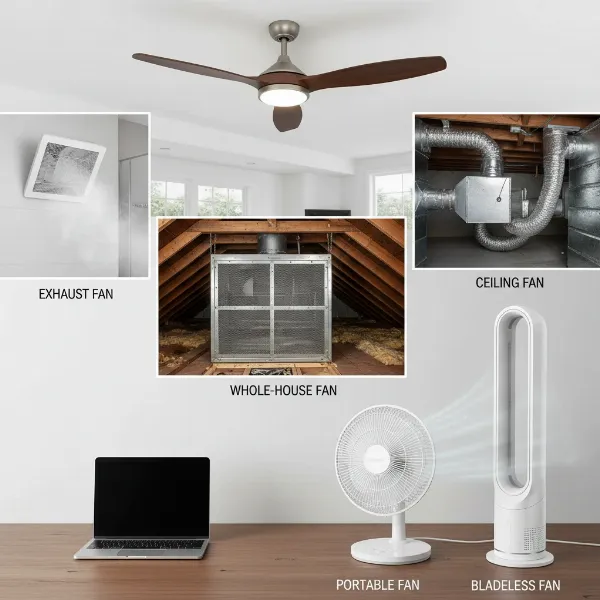 Various fan types like exhaust, ceiling, and whole-house, for different ventilation needs.
Guide to Choosing the Right Fan Size (CFM)
Choosing the correct fan size, determined by its CFM rating, is paramount for effective ventilation. An undersized fan won’t adequately refresh the air, while an oversized fan can lead to excessive energy use, noise, and discomfort.
Determining Your Ventilation Needs
Before calculating CFM, you need to assess the specific requirements of your space:
- Room Area/Volume: The fundamental starting point is the physical size of the room. You’ll need its length, width, and height in feet to calculate the total cubic footage.
- Purpose of Use: What kind of air movement is needed? Is it for general air circulation, exhausting moisture from a bathroom, removing fumes from a kitchen, or extracting dust from a workshop? Each purpose dictates a different air exchange rate.
- Specific Requirements: Consider any unique factors. Are there strong odors? High humidity? Heat-generating equipment? A high number of occupants? These conditions will necessitate a higher CFM.
|
Our Picks for the Best Electric fan in 2026
As an Amazon Associate I earn from qualifying purchases.
|
||
| Num | Product | Action |
|---|---|---|
| 1 | LEVOIT Tower Fan for Bedroom, 25ft/s Velocity Standing Fan with 28dB Quiet for Sleep, Remoter, 12H Timer, 5 Speeds, 4 Modes, 90° Oscillation for Home, Office, Indoor, Bladeless 36 inch, White |

|
| 2 | Dreo Fan for Bedroom, 120° Oscillating Standing Fan, Quiet Floor Fan with DC Motor, Pedestal Fan for Room, 9 Speeds, 4 modes, 20dB, 120° Manual Vertical, 37-42" Adjustable Height, 9H Timer, Black |
|
| 3 | XPOWER FC-100S Multipurpose 11 Pro Air Circulator Utility Fan with Oscillating Feature |
|
| 4 | Viniper Portable Rechargeable Fan, Small Desk Fan : 3 Speeds & about 8-24 Hours Longer Working, 180 Rotation, Portable Desktop Fan Small but Mighty, Strong Wind (White, Light Black Blade)6.2 Inch |
|
| 5 | Dreo Tower Fan for Bedroom, 25ft/s Velocity Quiet Floor Fan, 90° Oscillating Fans for Indoors with 4 Speeds, 4 Modes, 8H Timer, Standing Fans, Bladeless Fan, Black, Nomad One (DR-HTF007) |
|
| 6 | Amazon Basics Air Circulator Fan, Desk Fan for Bedroom, Home and Office, With 90-Degree Tilt Head, 3 Speed Settings, Lightweight (3 LBS), 35 Watts, Black, 11.1"W x 6.3"D x 10.9"H |
|
| 7 | 10" Modern Standing Fan for Bedroom, Sleek Oscillating Pedestal Fan, 3-Speed & Height Adjustable Compact Floor Fan for Home Office & Dorm |
|
| 8 | Lasko 2520 Oscillating Stand Fan,White 16 Inch |
|
| 9 | Dreo Fan for Bedroom, 120° Oscillating Standing Fans, Quiet Floor Fan with DC Motor, 100ft Pedestal Fans for Room, 9 Speeds, 4 modes, 20dB, 120° Manual Vertical, 37-42" Adjustable Height, 9H Timer |
|
| 10 | Amazon Basics 16" Pedestal Fan with Remote, Floor Fan, Standing Fan for Bedroom, Living Room, Office, with 3 Speeds, 3 Modes, Timer, Dual-Layered Blades, Adjustable Height, Tilt Head, 60W, Black |
|
Key Criteria for Fan Sizing
The core of selecting the right fan lies in understanding the CFM calculation and other critical performance factors.
CFM Calculation Formula: The Air Changes Per Hour (ACH) Method
The most widely used method for calculating the required CFM for a room involves determining its volume and the desired Air Changes per Hour (ACH). ACH signifies how many times the entire volume of air in a room is replaced within one hour.
Steps to Calculate CFM:
- Calculate Room Volume:
Room Volume (cubic feet) = Length (ft) × Width (ft) × Height (ft) - Determine Desired Air Changes Per Hour (ACH):
This value varies significantly based on the room’s function and specific ventilation needs. General recommendations exist for different spaces:- Bathrooms: Typically require 8-10 ACH, or at least 1 CFM per square foot of floor area. For bathrooms smaller than 100 sq ft, a minimum of 50 CFM is often recommended, increasing for larger or heavily used bathrooms.
- Kitchens: Need higher ACH (often 15-20+) to quickly remove cooking odors and grease.
- Bedrooms/Living Rooms: Generally require 4-6 ACH for general comfort.
- Workshops/Garages: Can range from 5-10 ACH, or more if generating significant dust or fumes.
- Offices: Typically 6-8 ACH.
- Assembly Halls: 4-8 ACH.
- Storage Areas: Lower ACH, often 2-4.
- Note: Local building codes and specific standards (like ASHRAE 62.2 for residential ventilation) should always be consulted for precise requirements.
- Calculate Required CFM:
CFM = (Room Volume (cubic feet) × Desired ACH) / 60(to convert hours to minutes)
Example: For a bathroom measuring 8 ft long, 5 ft wide, with an 8 ft ceiling, and a desired ACH of 8:
Room Volume = 8 ft × 5 ft × 8 ft = 320 cubic feet
Required CFM = (320 cubic feet × 8 ACH) / 60 = 2560 / 60 ≈ 42.67 CFM
Since 50 CFM is a common minimum for bathrooms, rounding up to the nearest standard size (e.g., 50 CFM or 80 CFM) would be appropriate.
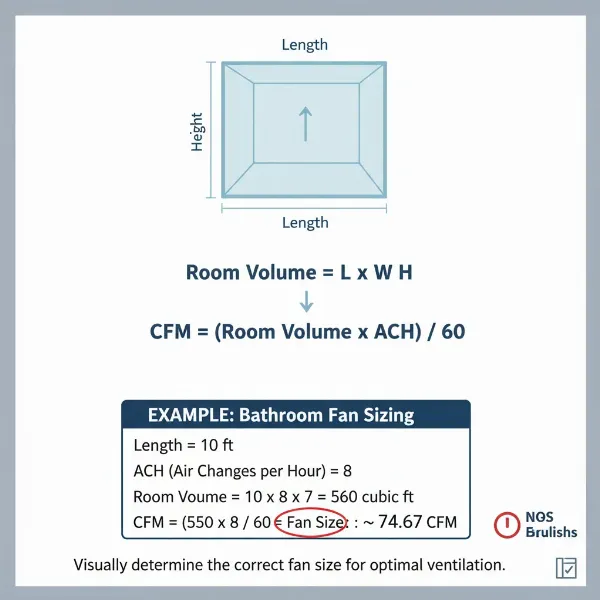 Diagram illustrating room volume and CFM calculation for effective ventilation.
Other Important Fan Criteria
- Noise Level (Sones): Especially critical for residential fans (e.g., bathroom exhaust fans). Sones measure sound output, with lower numbers indicating quieter operation (e.g., 1.0 sone is very quiet, 4.0 sones is noticeable).
- Features: Look for timers, humidity sensors (for automatic operation in bathrooms), remote controls, multiple speed settings, and smart home compatibility for convenience and efficiency.
- Brand and Reliability: Reputable brands often offer better warranty support, consistent performance, and higher quality components.
- Energy Efficiency: Look for ENERGY STAR certified fans, which are designed to consume less power while providing adequate airflow, reducing operating costs.
Comparing Common Fan Types and Their CFM Applications
Different fan types are optimized for various CFM requirements and applications:
- Exhaust Fans (Bathroom/Kitchen): Focus heavily on CFM to remove pollutants. Bathroom fans typically range from 50-150 CFM, while kitchen range hoods can go from 100 CFM to over 1000 CFM depending on stove power and kitchen size.
- Ceiling Fans: Their CFM ratings (often 2000-8000+) refer to the amount of air they move to create a breeze. They do not provide air exchange. Larger blades and steeper pitches generally result in higher CFM.
- Whole-House Fans: These have some of the highest CFM ratings (2000-6000+ CFM) to rapidly exchange the air in an entire home, drawing in cool outdoor air.
- Inline Duct Fans: CFM varies widely based on duct diameter and length, as well as the static pressure they need to overcome. They can provide supplemental airflow where needed.
“Matching the fan’s CFM to the room’s volume and specific ventilation needs is the most crucial step in achieving comfortable and healthy indoor air quality.” – Dr. Elena Petrova, Environmental Engineering Consultant
CFM Calculation Chart and Best Fan Models
The following chart illustrates typical CFM requirements based on common room types and recommended air changes per hour (ACH). Remember, these are guidelines, and specific situations may require adjustment.
| Room Type | Recommended ACH | Example Room (L x W x H) | Room Volume (cu ft) | Calculated CFM (approx.) |
|---|---|---|---|---|
| Bathroom | 8-10 | 8′ x 5′ x 8′ | 320 | 43-53 CFM |
| Kitchen | 15-20 | 10′ x 12′ x 8′ | 960 | 240-320 CFM |
| Bedroom | 4-6 | 12′ x 10′ x 8′ | 960 | 64-96 CFM |
| Living Room | 4-6 | 15′ x 20′ x 8′ | 2400 | 160-240 CFM |
| Office | 6-8 | 10′ x 10′ x 8′ | 800 | 80-107 CFM |
| Laundry Room | 8-10 | 7′ x 7′ x 8′ | 392 | 52-65 CFM |
| Garage/Workshop | 10-15 | 20′ x 20′ x 10′ | 4000 | 667-1000 CFM |
- Note: For kitchen range hoods, a common rule of thumb is 100 CFM for every 10,000 BTUs of stove burner output, or 1 CFM per square foot of kitchen area for general ventilation, whichever is higher for best results. Always factor in ductwork length and bends, which can increase static pressure and reduce effective CFM.
Tips for Using and Maintaining Your Fan for Optimal Airflow
Proper use and regular maintenance are essential to ensure your fan consistently delivers its rated CFM and maintains optimal performance throughout its lifespan.
Proper Fan Cleaning
Dust and grime are the arch-enemies of fan efficiency, accumulating on blades, grilles, and motors, which can significantly reduce airflow (CFM) and increase noise.
- Frequency: Clean portable fans weekly or bi-weekly. Exhaust and ceiling fans should be cleaned at least every 3-6 months, more frequently in dusty or greasy environments like kitchens.
- Tools Needed: Soft cloths, mild detergent, a vacuum cleaner with a brush attachment, and a screwdriver for disassembling grilles if necessary.
- Steps for Cleaning:
- Safety First: Always unplug the fan or turn off the power at the circuit breaker for hardwired fans before cleaning.
- Disassemble: Remove grilles or protective covers (if possible) according to the manufacturer’s instructions.
- Vacuum/Wipe Blades: Use a vacuum to remove loose dust. Then, wipe fan blades and interior surfaces with a damp cloth and a mild soap solution. For stubborn grease, a degreaser might be needed.
- Clean Exterior: Wipe down the fan housing and exterior grilles.
- Dry Thoroughly: Ensure all components are completely dry before reassembling and restoring power.
Safe and Effective Fan Use
Maximizing airflow and efficiency isn’t just about the right CFM; it’s also about how you use the fan.
- Optimal Placement: For exhaust fans, ensure they are positioned to capture the most pollutants (e.g., above a shower or stove). For circulation fans, place them where they can create a cross-breeze or directly move air towards occupants.
- Adjust Speed Appropriately: Use higher speeds for rapid air changes (e.g., after cooking or a shower) and lower speeds for continuous, quiet background ventilation. Running a fan too fast unnecessarily wastes energy and generates more noise without a proportionate increase in comfort or air quality.
- Avoid Obstructions: Ensure no furniture, curtains, or other objects block the fan’s intake or exhaust vents, as this can severely restrict airflow and reduce effective CFM.
- Consider Humidity and Temperature: In humid environments, a humidity-sensing fan can automatically adjust its operation, ensuring moisture is removed efficiently without continuous, unnecessary running.
Fan Maintenance for Extended Lifespan and Consistent CFM
Beyond routine cleaning, periodic maintenance can prevent issues and prolong your fan’s life.
- Check for Wear and Tear: Inspect fan blades for damage, wobble, or excessive dirt. Listen for unusual noises, which could indicate motor or bearing issues.
- Lubrication: Some older fan motors or those with specific bearing types may require occasional lubrication. Consult your owner’s manual for guidance. Modern sealed motors typically do not need lubrication.
- Ductwork Inspection (for exhaust fans): Ensure ductwork is clean, free of obstructions, and properly sealed. Leaks or blockages in ducts can drastically reduce the effective CFM delivered to a room.
- Proper Storage: If storing seasonal fans, clean them thoroughly and cover them to prevent dust accumulation.
Where to Purchase Reputable Fans (and Consider CFM Ratings)
Investing in a quality fan that meets your calculated CFM needs is an investment in comfort and air quality. Here are some reliable places to purchase fans:
- Major Appliance and Electronics Stores: Retailers like Best Buy, Lowe’s, and Home Depot offer a wide selection of ceiling fans, portable fans, and exhaust fans from various reputable brands.
- Online Retailers: Amazon, Wayfair, and manufacturer websites often provide extensive product details, customer reviews, and competitive pricing, making it easy to compare CFM ratings and features.
- HVAC Supply Stores: For more specialized ventilation needs, such as inline duct fans or commercial-grade exhaust systems, local HVAC supply houses can offer expert advice and professional-grade equipment.
- Specialty Fan Retailers: Some online or brick-and-mortar stores focus solely on fans, offering a curated selection and expert knowledge.
When buying, always:
- Verify CFM Specifications: Ensure the fan’s advertised CFM aligns with your calculated needs.
- Check Sone Ratings: Prioritize lower sone ratings for quiet operation, especially in living spaces.
- Look for Certifications: ENERGY STAR certification indicates energy efficiency.
- Review Warranty Information: A good warranty provides peace of mind regarding product longevity.
Fan Buying Guide: Your CFM Checklist
Navigating the world of fans can be complex, but focusing on key questions will simplify your decision-making process.
What’s your budget?
Fan prices vary significantly based on type, brand, features, and CFM. Establishing a budget early helps narrow down your options. For basic portable fans, you might spend $20-$50. High-end bathroom exhaust fans with advanced features can cost $150-$300+, while powerful whole-house fans or industrial units can run into hundreds or thousands of dollars. Remember that a slightly higher initial investment for an energy-efficient fan with the correct CFM can lead to long-term savings on electricity and maintenance, as well as improved comfort.
What’s your room size?
The dimensions of your room are the foundation of your CFM calculation. This isn’t just about square footage, but also ceiling height, which determines the room’s total cubic volume. A small fan in a large room will be ineffective, while an excessively powerful fan in a small space can create uncomfortable drafts and unnecessary noise. Always measure your room (length x width x height) before shopping. This critical step ensures you purchase a fan that can adequately ventilate or circulate air throughout the entire space, preventing ineffective performance or energy waste.
What features do you need?
Beyond raw CFM, modern fans come with a host of features designed to enhance convenience, efficiency, and comfort. Consider:
- Quiet Operation (Low Sones): Essential for bedrooms, living rooms, and bathrooms.
- Smart Controls: Wi-Fi connectivity, app control, or integration with smart home systems.
- Humidity Sensors: For automatic operation in bathrooms to combat moisture.
- Timers/Automatic Shut-off: To save energy and ensure the fan doesn’t run longer than necessary.
- Multiple Speed Settings: Allows for versatile use, from gentle airflow to rapid air changes.
- Directional Airflow: Important for ceiling fans or targeted cooling.
- Energy Efficiency Certification (ENERGY STAR): Reduces running costs.
Prioritize features that genuinely benefit your specific application and lifestyle.
Conclusion
Mastering CFM calculations is not just about numbers; it’s about creating healthier, more comfortable, and energy-efficient living and working environments. By understanding your space’s volume and the necessary air changes per hour, you can accurately determine the CFM required for optimal ventilation. From the quiet hum of a bathroom exhaust fan to the powerful whoosh of a whole-house fan, each plays a vital role in maintaining air quality. Choosing the right fan size means preventing stuffy rooms, mitigating odors, controlling humidity, and ultimately, enhancing your overall well-being. So, armed with this knowledge, are you ready to breathe easier with perfectly sized ventilation?
Frequently Asked Questions
What does “CFM” stand for in relation to fans?
CFM stands for Cubic Feet per Minute. It is a measurement that quantifies the volume of air a fan or ventilation system moves in one minute, serving as a critical indicator of its airflow capacity and effectiveness.
How do I quickly estimate CFM for a small room?
For a quick estimate for small rooms like bathrooms, a general rule of thumb is 1 CFM per square foot of floor area. For example, a 50 sq ft bathroom would need at least 50 CFM. However, for more precise needs, especially with higher ceilings or specific activities, using the full ACH calculation is recommended.
Can a fan have too high a CFM for a room?
Yes, a fan can have too high a CFM. While more air movement might seem better, excessive CFM can lead to problems such as uncomfortable drafts, increased noise levels, higher energy consumption, and in some ventilation systems, issues with maintaining proper pressure or humidity control.
What is Air Changes per Hour (ACH) and why is it important for CFM?
Air Changes per Hour (ACH) is a metric that indicates how many times the entire volume of air in a room is replaced or “changed” with fresh air within one hour. It is crucial for CFM calculation because it directly determines the rate at which a fan needs to move air to achieve adequate ventilation for a given space.
Does static pressure affect fan CFM?
Yes, static pressure significantly affects a fan’s effective CFM. Static pressure refers to the resistance to airflow caused by ductwork, filters, grilles, and other obstructions within a ventilation system. A fan’s listed CFM is often its maximum free-air flow, but in a real-world ducted system, resistance will reduce the actual air delivered, requiring careful system design.
How often should I clean my fan to maintain its CFM?
The frequency of fan cleaning depends on the type of fan and its environment. Portable fans in regular use might need weekly or bi-weekly cleaning. Exhaust fans in bathrooms or kitchens, which handle moisture and grease, should be cleaned every 3-6 months. Regular cleaning prevents dust and debris buildup that can reduce a fan’s effective CFM.
Is an ENERGY STAR certified fan always better?
ENERGY STAR certified fans are generally better because they are designed to be more energy-efficient, meaning they move the same amount of air (CFM) using less electricity than conventional models. This translates to lower operating costs and a reduced environmental footprint, without compromising on performance for their rated CFM.