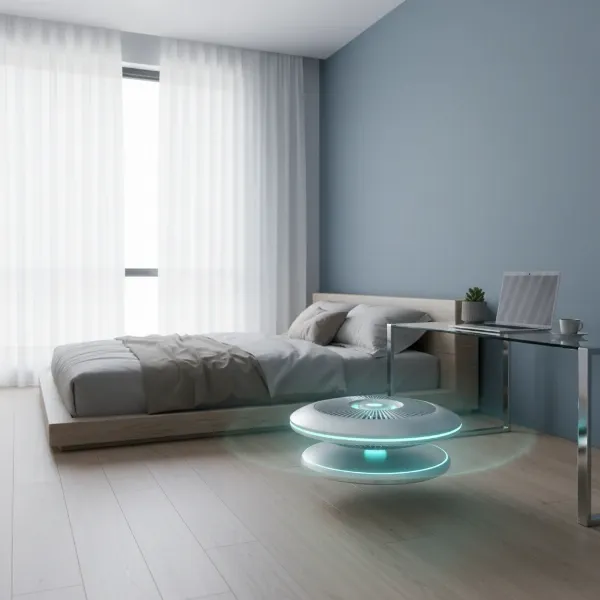
Are your indoor plants looking a little… uninspired? While grow lights and nutrient solutions often grab the spotlight, consistent air circulation is a silent powerhouse in fostering robust plant health. Think of it as the invisible force that mimics nature’s gentle breeze, crucial for everything from sturdy stems to preventing unseen threats. Whether you’re a seasoned indoor gardener or just starting your green journey, understanding the role of electric fans is paramount to cultivating a vibrant, high-yielding garden.
Electric Fans: Overview and Popular Types
Electric fans are more than just simple air movers; they are essential tools for creating a stable and productive microclimate for your plants. Proper air movement helps regulate critical environmental factors, directly impacting plant health and growth.
Why Air Circulation Matters:
- Temperature Regulation: Fans distribute heat evenly, preventing hot spots and cold pockets that can stress plants.
- Humidity Control: By keeping air moving, fans prevent moisture from settling on leaves, which reduces the risk of mold, mildew, and fungal infections.
- CO2 Distribution: Plants require carbon dioxide for photosynthesis. Fans ensure a consistent supply of CO2 to leaf surfaces, optimizing this vital process.
- Pest Deterrence: Moving air makes it more challenging for common pests to land and establish colonies on your plants.
- Stem Strengthening: A gentle breeze encourages plants to develop stronger stems and thicker stalks, mimicking natural outdoor conditions and increasing their resilience.
- Enhanced Transpiration: Air movement helps remove the humid layer around leaves, allowing plants to absorb more water and nutrients efficiently.
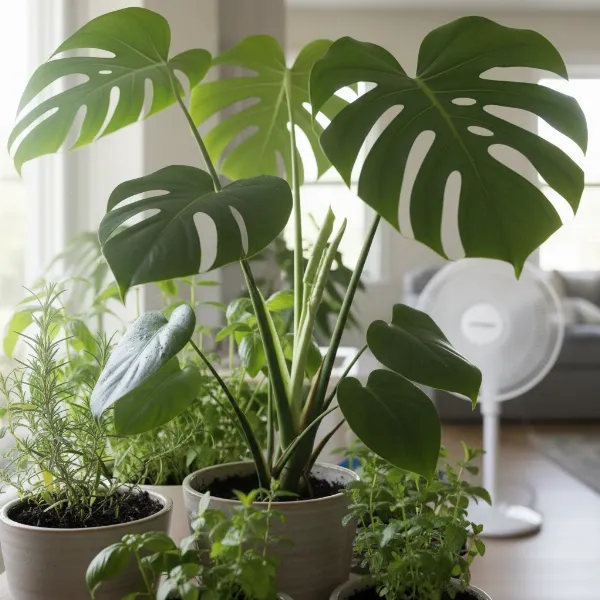 Indoor plants thriving with good air circulation, showing strong stems and healthy leaves
Types of Electric Fans for Plant Cultivation:
Indoor gardens often utilize a combination of fan types, each serving a distinct purpose within the ventilation system.
- Exhaust Fans (Extractor Fans): These are perhaps the most critical fans in any grow setup. Positioned at the top of your grow space (since hot air rises), exhaust fans actively pull stale, warm, and humid air out of the environment. They are essential for temperature control, managing humidity, and removing any odors.
- Intake Fans: Working in tandem with exhaust fans, intake fans introduce fresh air into the grow room. While passive intake (relying on negative pressure created by exhaust fans) can work for smaller setups, active intake with dedicated fans ensures a more consistent and robust supply of CO2-rich air.
- Circulation Fans (Horizontal Air Flow – HAF Fans): These fans are specifically designed to move air within the grow space, ensuring uniform air distribution among your plants. They prevent stagnant air pockets and reduce “wet patches” on leaves, promoting even growth. Unlike exhaust or intake fans, circulation fans should generally not blow directly onto plants with a harsh force.
- Oscillating Fans: A popular type of circulation fan, oscillating models rotate from side to side, providing broad coverage and a gentle, natural-feeling breeze across the plant canopy. They are excellent for overall air distribution and strengthening plant stems without causing stress.
- Clip-On Fans: Smaller and highly versatile, clip-on fans can be attached to tent poles or shelving. They are perfect for targeted airflow, addressing specific hot spots, increasing air movement through dense foliage, or managing localized humidity. Many clip-on fans also offer an oscillating feature for wider reach.
- Floor Fans/Pedestal Fans: These larger fans are suitable for bigger grow rooms, directing powerful airflow upwards to circulate air throughout the entire space.
- Wall-Mounted Fans: Offering a space-saving solution, wall-mounted fans can be strategically positioned to create horizontal airflow, targeting specific areas of the grow room without occupying valuable floor space.
- Inline Fans (Duct Fans): These powerful fans are integrated into ducting systems, often in conjunction with carbon filters. They are typically centrifugal fans, designed to move air efficiently through long ducts and against resistance, such as that provided by carbon filters for odor control or air scrubbers. They act as the primary air exchange system for both exhaust and intake in many professional setups.
Choosing the Right Electric Fan for Your Plants
Selecting the ideal fan system requires careful consideration of your specific growing environment and plant needs. There’s no one-size-fits-all solution, but by evaluating key factors, you can make an informed decision.
Determining Your Usage Needs
Before diving into specifications, consider the unique characteristics of your grow space.
- Grow Space Size and Volume: The dimensions of your grow room or tent are crucial for calculating the required airflow capacity, measured in Cubic Feet per Minute (CFM). A general rule of thumb for exhaust fans is to be able to exchange the entire air volume of your space every 1-3 minutes. For example, if your grow tent is 4ft x 4ft x 7ft, its volume is 112 cubic feet. You’d want an exhaust fan with a CFM rating around 112 CFM or higher. Additional factors like grow lights (which generate heat), carbon filters, and long ducting can require a more powerful fan, so it’s often wise to multiply your base CFM by a factor of 1.5 to 3.5.
- Purpose of Use: Are you primarily focused on temperature control, humidity reduction, CO2 distribution, or strengthening plant stems? Different fan types excel at different tasks. For instance, inline fans are for air exchange, while oscillating fans are for internal circulation.
- Budget: Fans come in a wide range of prices. Establish a budget, but remember that investing in reliable, energy-efficient fans can save money in the long run through lower operating costs and better plant health.
|
Our Picks for the Best Electric fan in 2026
As an Amazon Associate I earn from qualifying purchases.
|
||
| Num | Product | Action |
|---|---|---|
| 1 | Amazon Basics 16" Pedestal Fan with Remote, Floor Fan, Standing Fan for Bedroom, Living Room, Office, with 3 Speeds, 3 Modes, Timer, Dual-Layered Blades, Adjustable Height, Tilt Head, 60W, Black |

|
| 2 | Lasko 2520 Oscillating Stand Fan,White 16 Inch |
|
| 3 | Viniper Portable Rechargeable Fan, Small Desk Fan : 3 Speeds & about 8-24 Hours Longer Working, 180 Rotation, Portable Desktop Fan Small but Mighty, Strong Wind (White, Light Black Blade)6.2 Inch |
|
| 4 | Dreo Fan for Bedroom, 120° Oscillating Standing Fans, Quiet Floor Fan with DC Motor, 100ft Pedestal Fans for Room, 9 Speeds, 4 modes, 20dB, 120° Manual Vertical, 37-42" Adjustable Height, 9H Timer |
|
| 5 | 10" Modern Standing Fan for Bedroom, Sleek Oscillating Pedestal Fan, 3-Speed & Height Adjustable Compact Floor Fan for Home Office & Dorm |
|
| 6 | Dreo Fan for Bedroom, 120° Oscillating Standing Fan, Quiet Floor Fan with DC Motor, Pedestal Fan for Room, 9 Speeds, 4 modes, 20dB, 120° Manual Vertical, 37-42" Adjustable Height, 9H Timer, Black |
|
| 7 | XPOWER FC-100S Multipurpose 11 Pro Air Circulator Utility Fan with Oscillating Feature |
|
| 8 | Dreo Tower Fan for Bedroom, 25ft/s Velocity Quiet Floor Fan, 90° Oscillating Fans for Indoors with 4 Speeds, 4 Modes, 8H Timer, Standing Fans, Bladeless Fan, Black, Nomad One (DR-HTF007) |
|
| 9 | Amazon Basics Air Circulator Fan, Desk Fan for Bedroom, Home and Office, With 90-Degree Tilt Head, 3 Speed Settings, Lightweight (3 LBS), 35 Watts, Black, 11.1"W x 6.3"D x 10.9"H |
|
| 10 | LEVOIT Tower Fan for Bedroom, 25ft/s Velocity Standing Fan with 28dB Quiet for Sleep, Remoter, 12H Timer, 5 Speeds, 4 Modes, 90° Oscillation for Home, Office, Indoor, Bladeless 36 inch, White |
|
Important Criteria When Choosing a Fan
Once you understand your needs, evaluate fans based on these critical features:
- Airflow Capacity (CFM): As mentioned, this is paramount. Ensure the fan’s CFM matches or exceeds your grow space’s requirements, accounting for any restrictive components like filters.
- Noise Level: Some fans can be quite loud, which might be a concern if your grow space is in a living area. Look for models explicitly advertised as “quiet” or “ultra-quiet,” often featuring EC (Electronically Commutated) motors for smoother, quieter operation compared to older AC (Alternating Current) motors.
- Features:
- Speed Control: Absolutely essential. The ability to adjust fan speed allows you to fine-tune airflow for different growth stages, from gentle breezes for seedlings to stronger circulation for mature plants.
- Oscillation: For circulation fans, oscillation provides more even air distribution and prevents wind burn on individual plants.
- Remote Control/Smart Features: Some advanced fans offer remote control or integrate with smart environmental controllers, allowing for automated adjustments based on temperature and humidity readings.
- Brand and Reliability: Research reputable brands known for durability and performance in horticultural applications. Fans designed for continuous operation are a better long-term investment.
- Energy Efficiency: Opt for fans with energy-efficient motors to keep your electricity bills in check. EC motors are generally more efficient.
Comparing Popular Electric Fan Types
The optimal fan setup often involves a combination of types.
| Fan Type | Primary Function | Pros | Cons | Best Use Case |
|---|---|---|---|---|
| Inline (Duct) | Air exchange (exhaust/intake), odor control | Powerful, efficient with ducting/filters | Can be noisy, requires ducting | Main ventilation, temperature/humidity/odor control |
| Oscillating | Internal air circulation, stem strengthening | Even distribution, mimics natural breeze | Can be bulky, less targeted airflow | General circulation, plant strengthening |
| Clip-On | Targeted internal airflow, hot spot prevention | Compact, flexible placement, affordable | Limited coverage, less powerful | Small spaces, targeted air movement within canopy |
| Floor/Pedestal | Large area circulation, upward airflow | High airflow for large rooms | Takes up floor space, can be powerful for small plants | Larger grow rooms/greenhouses for general circulation |
| Wall-Mounted | Internal circulation, space-saving | Out of the way, effective for specific areas | Fixed position (unless oscillating) | Optimizing space, directed airflow in medium-sized setups |
Top Electric Fans for Plant Cultivation: A Comparison
Many brands offer excellent solutions for plant growers. Here are some highly-regarded options across different fan categories:
- For Inline Ventilation (Exhaust/Intake):
- AC Infinity Cloudline Series (S & T models): Often praised for their quiet operation, energy efficiency, and smart control capabilities. The T-series includes a thermostat and humidity controller for automated environmental management. These are premium options known for reliability.
- VIVOSUN Inline Duct Fans: A popular choice for their value and effectiveness, especially for new growers. While generally good for performance, some users report varying durability over time compared to higher-end models.
- Mars Hydro Inline Fans: Known for offering a range of sizes with features like speed control, Bluetooth connectivity, and thermostat integration, catering to diverse grow tent needs.
- Can-Fan Max-Fan / Vortex S-Line: These brands offer robust, high-performance inline fans suitable for more demanding ventilation systems, often used in larger grow rooms.
- For Internal Circulation (Oscillating/Clip-On):
- Comfort Zone Pedestal Fans: These oscillating pedestal fans are often cited as affordable and effective for general circulation in larger grow areas, offering multiple speed settings.
- Air King Commercial Grade Oscillating Wall Mount Fans: Known for their durability and powerful airflow, suitable for those needing a robust wall-mounted solution.
- Active Air HORF Series: Offers ultra-quiet brushless clip-on fans, ideal for smaller tents or specific canopy areas where noise is a concern.
- Honeywell HT900 TurboForce Fan: While not oscillating, this compact fan is frequently recommended for its surprising power and durability, often used as a static clip-on or small floor fan to move a significant amount of air.
When choosing, consider reviews, specific features like speed settings, oscillation, and of course, the fan’s power (CFM) relative to your grow space.
Tips for Using and Maintaining Your Electric Fan for Plants
Proper setup and routine maintenance will ensure your fans operate efficiently and provide the best environment for your plants.
Cleaning Your Electric Fan Correctly
Dust and debris can accumulate on fan blades and grilles, reducing efficiency and potentially causing motor strain.
- Frequency: Aim for regular cleaning, ideally every few weeks, or more often in dusty environments.
- Tools: A soft brush, microfiber cloth, compressed air, and a damp cloth are usually sufficient.
- Steps:
- Always unplug the fan before cleaning.
- Carefully remove the front grille (if possible) and wipe down the blades to remove dust and buildup.
- Use compressed air to clear dust from hard-to-reach areas around the motor.
- Clean the grilles with a damp cloth and let them dry completely before reassembling.
Safe and Effective Use of Electric Fans
Strategic placement and operation are key to maximizing benefits while avoiding potential harm to your plants.
- Placement:
- Exhaust fans should be at the top of your grow space to remove rising hot air.
- Circulation fans (oscillating, clip-on, floor, wall-mounted) should be positioned to create a gentle, even breeze across the plant canopy, avoiding direct, concentrated blasts of air. Placing them at various heights or in opposing corners can create a beneficial vortex effect.
- Adjusting Fan Speed: Start with the lowest speed setting and gradually increase it as plants grow. Young seedlings are more delicate and require less intense airflow than mature plants. The goal is gentle leaf rustling, not vigorous shaking. Excessive wind can cause “wind burn,” water stress, and even stem damage.
- Avoid Constant Direct Airflow: While continuous air movement is beneficial, constantly blasting a single plant directly can be detrimental. Oscillating fans help mitigate this by distributing air more broadly.
- Consider Multiple Fans: In larger grow rooms or those with complex plant arrangements, using several smaller circulation fans is often more effective than one large fan, ensuring comprehensive air distribution and eliminating dead zones.
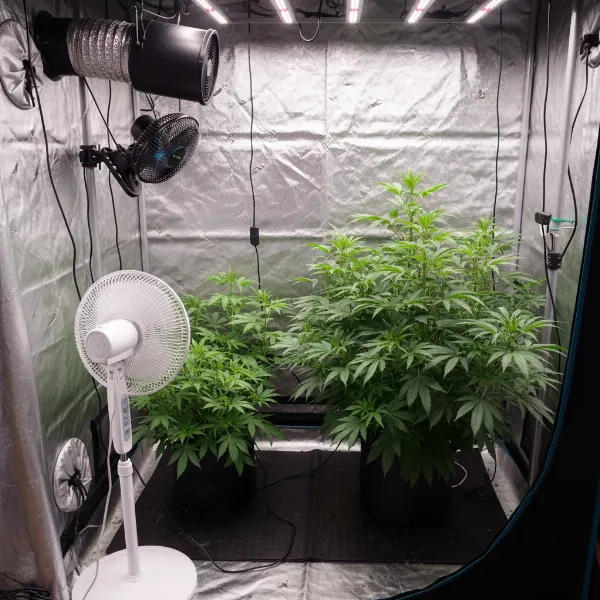 A well-ventilated indoor grow room with multiple fans strategically placed for optimal air circulation
Maintaining Electric Fans for Extended Lifespan
Like any equipment, fans benefit from ongoing care.
- Regular Inspections: Periodically check for any loose parts, unusual noises, or vibrations that could indicate a problem.
- Lubrication: Some fan motors may require occasional lubrication, though many modern fans are designed to be maintenance-free in this regard. Consult your fan’s manual.
- Proper Storage: If storing fans during off-season, clean them thoroughly and keep them in a dry, dust-free environment.
Where to Purchase Reliable Electric Fans for Plants
Finding quality electric fans is easier than ever, with many options available to growers.
- Specialty Hydroponic and Garden Stores: These stores often stock fans specifically designed for grow room environments, and their staff can offer expert advice tailored to your needs.
- Online Retailers: Websites like Amazon, along with dedicated hydroponics or indoor gardening e-commerce sites, offer a vast selection of brands and models, often with competitive pricing and customer reviews.
- General Electronics Retailers: For basic circulation fans or clip-on models, general electronics stores might carry suitable options, though it’s important to check specifications for continuous duty and reliability.
When purchasing, always verify the product’s warranty and check for clear return policies. Inspect the fan upon arrival for any damage and ensure all components are included.
Electric Fan Buying Guide: Your Questions Answered
Making the right choice can seem overwhelming with so many options. Let’s break down the essential questions to guide your decision.
What is your budget?
Your budget will significantly influence the type and features of fans you can consider. While inexpensive fans might seem appealing, investing a bit more in durable, energy-efficient models with speed control often proves more cost-effective in the long run. High-quality fans designed for continuous use will last longer and perform more reliably, reducing replacement costs and potential crop issues.
What is the size of your grow room or tent?
This is the most crucial factor for determining the necessary fan power. Measure the length, width, and height of your grow space in feet to calculate its cubic volume. This volume directly informs the CFM (Cubic Feet per Minute) rating required for your exhaust and intake fans. For internal circulation, larger spaces will benefit from multiple fans or larger oscillating units to ensure even air distribution.
What features do you need?
Consider which features are non-negotiable for your setup:
- Oscillation: Essential for even air distribution and plant strengthening in most grow tents.
- Speed Control: Highly recommended to adjust airflow for different plant stages and environmental conditions.
- Quiet Operation: Important if your grow space is in a noise-sensitive area. Look for fans with EC motors.
- Mounting Options: Do you need a clip-on, wall-mounted, floor, or inline fan? This depends on your space constraints and desired airflow direction.
- Smart Features: Integration with environmental controllers, timers, or remote control can automate and simplify your grow room management.
By thoughtfully answering these questions, you’ll be well-equipped to select the electric fans that will provide the optimal airflow and environment for your plants to flourish.
Conclusion
Creating an ideal indoor growing environment is a delicate balance, and electric fans play a critical, often underestimated, role in this ecosystem. From regulating temperature and humidity to ensuring vital CO2 distribution and strengthening plants against disease and pests, the benefits of proper air circulation are undeniable. By understanding the different types of fans available—from powerful inline exhaust systems to versatile oscillating and clip-on circulation units—and carefully considering your specific needs and criteria, you can choose the best tools to nurture a thriving plant collection. A well-ventilated grow space is a happy grow space, leading to healthier plants and more abundant yields.
What kind of electric fan setup has brought the most success to your indoor garden?