As a technician with over a decade of experience deep in the world of electric fans, I’ve seen countless models, from the time-honored classics to the most cutting-edge innovations. When it comes to garages and workshops, the right fan isn’t just about moving air; it’s about creating a comfortable, safe, and productive environment. Lingering fumes, stifling heat, and persistent dust can turn any project into a headache. This comprehensive guide will illuminate the best industrial electric fans available, helping you cut through the noise and choose a unit that truly transforms your workspace.
Industrial Fans: Overview and Popular Types
Industrial fans are specifically engineered to tackle the demanding conditions of workshops and garages, providing robust air circulation and ventilation. Unlike standard household electric fans, these units are built to withstand harsher environments, larger spaces, and specialized needs like fume extraction or dust control. Their evolution has brought forth a variety of designs, each optimized for different applications and spatial requirements.
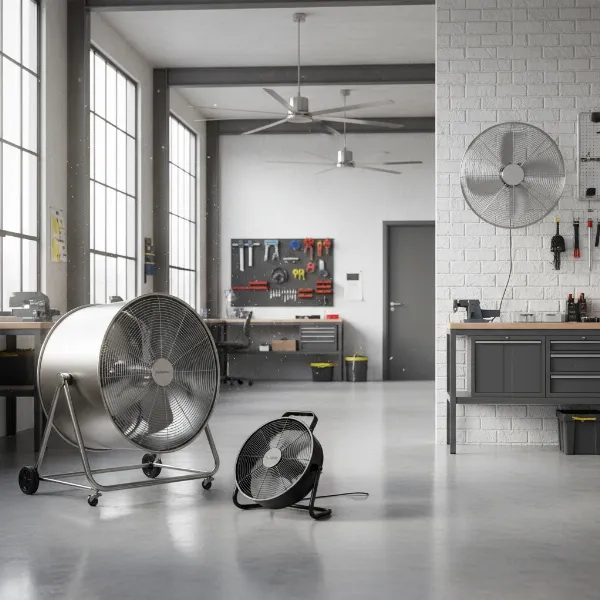 Various industrial fans, including drum, floor, wall-mounted, and ceiling, in a clean workshop.
Let’s explore the most popular types of industrial fans:
-
Drum/Barrel Fans: These large, high-velocity electric fans are housed in a cylindrical drum, making them incredibly effective at moving a substantial volume of air. Often equipped with wheels and handles, they are highly portable, allowing you to direct powerful airflow exactly where it’s needed. They are ideal for cooling large areas or rapidly evacuating stale air.
- Pros: Exceptionally high CFM, robust construction, great for rapid air turnover.
- Cons: Can be bulky, often louder on higher settings.
-
Floor Fans: Versatile and often compact, floor fans are designed to sit directly on the ground or a sturdy workbench. Many models are high-velocity, pushing air across the floor to create a strong cooling effect or assist in drying surfaces. Some convertible models can also be wall-mounted.
- Pros: Good portability, generally affordable, can be directed precisely.
- Cons: Can take up floor space, may not be powerful enough for very large areas.
-
Wall-Mounted Fans: These space-saving electric fans are permanently affixed to a wall, keeping them out of the way of foot traffic and equipment. They are excellent for consistent, targeted airflow, often featuring oscillation and tilt capabilities to cover a wider area or focus on specific workstations.
- Pros: Saves floor space, provides consistent ventilation, often quieter than drum fans.
- Cons: Fixed position limits flexibility, installation requires drilling.
-
Ceiling Fans (including HVLS): For expansive garages and workshops, industrial-grade ceiling fans, particularly High Volume, Low Speed (HVLS) fans, offer unparalleled whole-space air circulation. They excel at destratification, mixing air layers to maintain a more uniform temperature throughout the year.
- Pros: Excellent for large areas, energy-efficient, quiet operation, year-round utility (cooling and heat distribution).
- Cons: Higher initial cost, requires permanent installation and electrical wiring, not suitable for small, low-ceiling spaces.
-
Air Movers: These specialized industrial electric fans generate extremely powerful, concentrated airflow, often resembling a large, rugged box or snail shell. Primarily used for drying wet surfaces (like floors or carpets) or rapidly ventilating very specific areas with intense fumes, air movers deliver industrial-grade performance.
- Pros: Unmatched air speed and drying capabilities, highly durable.
- Cons: Very loud, typically overkill for general cooling, can blow around loose items.
-
Jobsite/Portable Fans: Designed for flexibility, these smaller, lightweight electric fans often run on rechargeable batteries, offering cordless operation. They are built to be highly durable, surviving bumps and drops common in active work environments, providing personal cooling wherever you move.
- Pros: Extremely portable, durable, can be battery-powered, perfect for personal cooling.
- Cons: Lower CFM, often requires specific battery systems, may not be sufficient for whole-room cooling.
How to Choose the Right Industrial Fan for Your Workspace
Selecting the perfect industrial electric fan means understanding your environment and prioritizing what matters most. It’s not just about buying “a fan”; it’s about investing in a solution that enhances your productivity, safety, and comfort.
Determine Your Workspace Needs
Before diving into specifications, take a moment to assess your actual requirements. What problem are you trying to solve? Do you need to cool down a large area, clear welding fumes, or simply get a refreshing breeze while you work? Understanding the primary use helps narrow down the fan type.
- Room Size: Measure the square footage and, ideally, the cubic footage of your garage or workshop. This is crucial for determining the necessary airflow capacity (CFM). A small 2-car garage will have very different needs than a multi-bay workshop.
- Purpose of Use: Identify your main objective. Is it general cooling during hot summer months, targeted ventilation for welding or painting, dust control for woodworking, or reducing humidity to prevent rust on tools? Each purpose dictates different fan characteristics.
- Budget: Industrial fans range widely in price, from under $100 for basic floor models to several hundred or even thousands for high-end HVLS or specialized air movers. Set a realistic budget to guide your choices.
|
Our Picks for the Best Electric fan in 2026
As an Amazon Associate I earn from qualifying purchases.
|
||
| Num | Product | Action |
|---|---|---|
| 1 | 10" Modern Standing Fan for Bedroom, Sleek Oscillating Pedestal Fan, 3-Speed & Height Adjustable Compact Floor Fan for Home Office & Dorm |

|
| 2 | XPOWER FC-100S Multipurpose 11 Pro Air Circulator Utility Fan with Oscillating Feature |
|
| 3 | Lasko 2520 Oscillating Stand Fan,White 16 Inch |
|
| 4 | Amazon Basics Air Circulator Fan, Desk Fan for Bedroom, Home and Office, With 90-Degree Tilt Head, 3 Speed Settings, Lightweight (3 LBS), 35 Watts, Black, 11.1"W x 6.3"D x 10.9"H |
|
| 5 | Viniper Portable Rechargeable Fan, Small Desk Fan : 3 Speeds & about 8-24 Hours Longer Working, 180 Rotation, Portable Desktop Fan Small but Mighty, Strong Wind (White, Light Black Blade)6.2 Inch |
|
| 6 | Dreo Fan for Bedroom, 120° Oscillating Standing Fans, Quiet Floor Fan with DC Motor, 100ft Pedestal Fans for Room, 9 Speeds, 4 modes, 20dB, 120° Manual Vertical, 37-42" Adjustable Height, 9H Timer |
|
| 7 | Dreo Tower Fan for Bedroom, 25ft/s Velocity Quiet Floor Fan, 90° Oscillating Fans for Indoors with 4 Speeds, 4 Modes, 8H Timer, Standing Fans, Bladeless Fan, Black, Nomad One (DR-HTF007) |
|
| 8 | Amazon Basics 16" Pedestal Fan with Remote, Floor Fan, Standing Fan for Bedroom, Living Room, Office, with 3 Speeds, 3 Modes, Timer, Dual-Layered Blades, Adjustable Height, Tilt Head, 60W, Black |
|
| 9 | Dreo Fan for Bedroom, 120° Oscillating Standing Fan, Quiet Floor Fan with DC Motor, Pedestal Fan for Room, 9 Speeds, 4 modes, 20dB, 120° Manual Vertical, 37-42" Adjustable Height, 9H Timer, Black |
|
| 10 | LEVOIT Tower Fan for Bedroom, 25ft/s Velocity Standing Fan with 28dB Quiet for Sleep, Remoter, 12H Timer, 5 Speeds, 4 Modes, 90° Oscillation for Home, Office, Indoor, Bladeless 36 inch, White |
|
Essential Criteria for Selection
Once you know your needs, evaluate potential electric fans against these key criteria. My experience shows that overlooking any of these can lead to buyer’s remorse and an underperforming fan.
- Airflow Capacity (CFM): Measured in Cubic Feet per Minute, CFM indicates how much air a fan moves. For effective air circulation in spaces up to 400 square feet, target 1,000–1,500 CFM. For 400–700 square feet, aim for 1,500–2,500 CFM, and for areas over 700 square feet, look for 2,500 CFM or more. Higher CFM generally means faster air turnover, which is critical for large, uninsulated spaces.
- Noise Level: Measured in decibels (dB), a fan’s noise output can significantly impact comfort and concentration. While powerful industrial fans are rarely silent, aim for models under 60 dB for continuous use if your workspace is near living areas or requires focus. Anything consistently above 85 dB would require hearing protection, as recommended by OSHA.
- Durability and Construction Materials: Garages and workshops are tough environments. Look for fans built with sturdy materials like powder-coated steel or robust, impact-resistant plastics. Metal blades, heavy-duty grills, and sealed motors are indicators of a fan that can withstand dust, debris, and accidental bumps.
- Features:
- Adjustable Speed Settings: Essential for adapting to varying temperatures and tasks. Most good industrial fans offer at least three speeds.
- Oscillation and Tilt: An oscillating head helps distribute air widely, while an adjustable tilt allows you to direct airflow precisely.
- Remote Control/Timer: Convenient for fans mounted out of reach or for automated operation.
- Smart Features: While less common on purely industrial models, some high-end units may offer Wi-Fi connectivity and app control.
- Mounting and Portability Options: Decide if you need a fan that can be easily moved (wheels, handles) or one that stays in a fixed position (wall-mounted, ceiling-mounted). Convertible fans offer the best of both worlds.
- Energy Efficiency: Modern electric fans often feature energy-efficient EC (electronically commutated) motors, which can consume up to 70% less energy than traditional AC motors while maintaining consistent performance. This can lead to significant savings on your electricity bill over time.
- Safety Features: Ensure the fan meets safety standards from organizations like ETL (Electronic Testing Laboratories) or UL (Underwriters Laboratories). IP (Ingress Protection) ratings are also crucial for resistance against dust and water splashes, especially in damp or dusty environments. An IP44 rating or higher is recommended for such conditions.
- Brand Reputation and Warranty: Trustworthy brands often provide better quality and support. A good warranty (e.g., 5 years) reflects a manufacturer’s confidence in their product’s longevity.
Comparing Popular Industrial Fan Types
Choosing between fan types can be challenging, but matching the fan to the job is key.
- Drum/Barrel Fans vs. Wall-Mounted Fans: Drum fans (like the Tornado 24″) offer immense portability and raw power, making them excellent for quickly cooling a large, open area or for tasks that require moving the fan often. Wall-mounted fans (such as the Air King 20″) save precious floor space and provide consistent, directed airflow, perfect for fixed workstations or long-term ventilation.
- Ceiling Fans vs. Portable Fans: Industrial ceiling fans, like the Westinghouse Jax 56″, are ideal for general, pervasive air circulation across a large footprint (up to 400 sq ft). They are energy-efficient for year-round temperature management. Portable fans, like the DeWalt 20V MAX Jobsite fan, excel at personal cooling and extreme mobility, especially for tasks that take you all over the workspace.
- Air Movers for Specific Tasks: If your primary concern is drying surfaces (e.g., after washing a vehicle or dealing with a leak) or rapid, localized fume extraction, an air mover like the Mounto Air Mover is unparalleled. Be prepared for significant noise, but also for its impressive ability to move air with force.
“The right fan isn’t just about blowing air; it’s about engineering a better environment. Consider how you use your space, the tasks you perform, and the challenges you face—heat, dust, fumes. That’s the blueprint for your perfect industrial fan.” – Admin, ElectricFanatic.com
Top Industrial Fans: A Comparative Table
Here’s a quick overview of some highly-rated industrial electric fans suitable for garages and workshops, based on market availability and expert reviews:
| Model | Type | Max CFM | Key Features | Pros | Cons |
|---|---|---|---|---|---|
| Tornado 24″ High-Velocity | Drum Fan | 8,540 | 3-speed, aluminum blades, wheels, handles | Powerful airflow, highly portable, durable steel/aluminum build | Can be loud on high, assembly required, bulky |
| Air King 20″ ⅙ HP Industrial-Grade | Wall-Mounted Fan | 3,670 | 3-speed, 360-degree rotation bracket, secondary support cable | Space-saving, robust, relatively quiet, excellent airflow direction | Pull-cord operation (no remote/dial), fixed position |
| Lasko High-Velocity Floor Fan | Floor/Convertible | 3,460 | 3-speed, pivoting head, rubber feet, wall-mount bracket included, remote | Versatile (floor/wall), quiet, stable, remote control included | Lower cooling power on low/medium settings, some assembly required |
| Maxx Air 24″ 2-Speed Tilting | Drum Fan | 4,000 | 2-speed, 180-degree tilt, powder-coated steel, wheels, OSHA compliant | Extremely durable, powerful, pre-assembled (just add wheels), energy-efficient | Fewer speed settings than rivals, heavier to carry, higher price point |
| DeWalt 20V MAX Cordless Jobsite | Portable | 650 | Variable speed, adjustable angle, cordless (battery), durable plastic | Incredibly portable, extremely durable, compact | Batteries sold separately, lower CFM (for personal cooling), no power cord |
| Mounto Air Mover | Air Mover | 46.9 mph (air speed) | Industrial-grade, 90/45 degree settings, heavy-duty | Unmatched power, excellent for drying and rapid air movement | Very loud, bulky, might be overkill for general use, high power consumption |
| Westinghouse Jax 56″ Industrial | Ceiling Fan | 4,833 | 5 forward/reverse speeds, wall-mounted controller, rust-resistant blades | Efficient for large spaces (up to 400 sq ft), year-round utility, quiet | Permanent installation (electrical wiring), no light kit, not portable |
Note: CFM ratings and other specifications can vary slightly by model year and retailer. Always check current product details before purchasing.
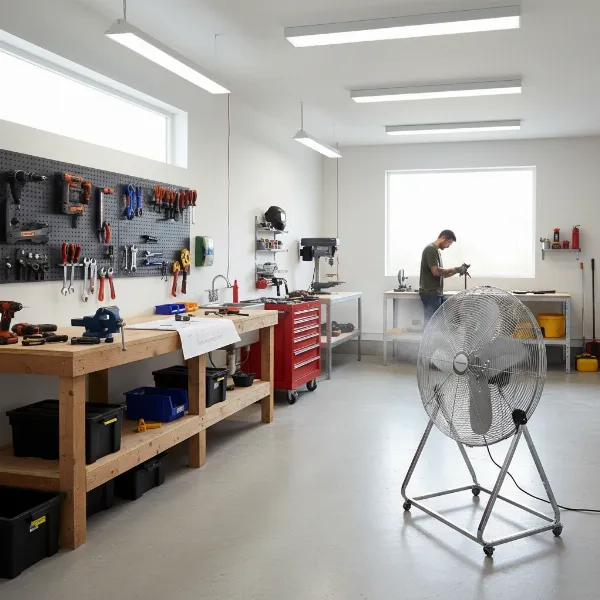 Industrial drum fan effectively cooling a busy garage workshop with tools and equipment.
Tips for Using and Maintaining Your Industrial Fan
To ensure your industrial electric fan provides years of reliable service and continues to keep your garage or workshop comfortable, proper use and maintenance are essential. As an electric fan expert, I can tell you that a little proactive care goes a long way in extending its lifespan and maintaining peak performance.
Proper Cleaning for Longevity
Dust and debris are the arch-enemies of fan motors and blades. Regular cleaning prevents buildup, reduces strain on the motor, and maintains airflow efficiency.
- Frequency: Aim to clean your fan every 3-6 months, or more frequently if you work in a particularly dusty environment (e.g., woodworking, grinding).
- Tools Needed: A vacuum cleaner with a brush attachment, compressed air, a soft cloth, and a mild detergent solution (for grilles and blades).
- Steps for Cleaning:
- Unplug the fan: Always disconnect power before any cleaning or maintenance.
- Remove Grilles: Most industrial fans have removable front and rear grilles. Carefully unfasten them according to your fan’s manual.
- Clean Blades: Use compressed air to blow off loose dust, then wipe the blades with a damp cloth. For stubborn grime, a mild detergent can be used, followed by a dry wipe. Ensure blades are completely dry before reassembly.
- Clean Grilles: Wash grilles with soap and water or wipe them down. Dry thoroughly.
- Wipe Motor Housing: Use a dry or slightly damp cloth to wipe down the exterior of the motor housing. Avoid getting water inside the motor.
Safe and Effective Operation
Beyond cleaning, how you use your fan directly impacts its efficiency and your safety.
- Optimal Placement: For general cooling, position fans to create a cross-breeze by drawing fresh air in and pushing hot, stale air out. For fume extraction, place the fan near the source of fumes, directing them towards an open door or window. Wall-mounted fans are best placed at a height that allows air to circulate over your work area without obstruction.
- Adjusting Speed: Use higher speeds for rapid cooling or fume extraction, but switch to lower settings for ambient air circulation to reduce noise and energy consumption once the desired effect is achieved.
- Avoid Continuous Use: While industrial fans are built for durability, continuous operation at maximum settings can still shorten motor life. Give your fan occasional breaks, especially during extremely long work sessions.
- Secure Installation: For wall-mounted and ceiling fans, ensure they are securely fastened to structural supports according to the manufacturer’s instructions. Use secondary safety cables if provided.
Extending Fan Lifespan
A few additional steps can help you get the most out of your industrial fan.
- Regular Inspection: Periodically check for any loose screws, rattling noises, or wobbling blades. Address these issues promptly to prevent further damage.
- Lubrication: Some older or heavy-duty models may require occasional lubrication of motor bearings. Refer to your fan’s manual for specific instructions; many modern fans have sealed, maintenance-free motors.
- Proper Storage: If you only use your fan seasonally, clean it thoroughly before storing it in a dry, covered area to protect it from dust and moisture.
Where to Buy Reliable Industrial Fans
Finding a trustworthy source for your industrial electric fan is just as important as choosing the right model. You want assurance of quality, a valid warranty, and good customer service.
Reputable retailers for industrial fans include:
- Large Home Improvement Stores: Stores like The Home Depot and Lowe’s often carry a selection of industrial floor, drum, and wall-mounted fans.
- Online Marketplaces: Amazon, Walmart, and Zoro offer a vast selection with competitive pricing and user reviews. Be sure to check seller ratings.
- Industrial Supply Companies: For heavy-duty or specialized units, companies like Grainger or directly from manufacturer websites (e.g., Hunter Industrial Fans, Big Ass Fans) are excellent sources.
- Specialty Fan Retailers: Some online and brick-and-mortar stores focus exclusively on ventilation solutions, offering expert advice and a broader range of industrial-grade products.
When making a purchase, always remember to:
- Inspect the Product: Even when buying online, review product images for material quality. In-store, physically check for sturdy construction.
- Verify Warranty: Confirm the warranty period and what it covers. A strong warranty is a sign of a reliable product.
- Read Reviews: Customer feedback can offer invaluable real-world insights into a fan’s performance, durability, and any potential quirks.
Industrial Fan Buying Guide: Your Questions Answered
Making an informed decision about an industrial fan requires considering several key factors that directly impact its effectiveness in your unique workspace.
What is your budget for an industrial fan?
Industrial fans can range from under $100 for basic models to over $500 for high-performance or specialized units. Setting a budget helps you focus on options that offer the best balance of features, durability, and airflow for your price range, ensuring you get value without overspending.
What is the size of your garage or workshop?
The size of your space directly dictates the required airflow, measured in CFM. A smaller home garage (under 400 sq ft) might be well-served by a 1,500 CFM floor or wall fan, while a large commercial workshop (over 700 sq ft) will need 2,500 CFM or more, often from drum or industrial ceiling fans, to achieve effective cooling and ventilation.
What specific features do you need in an industrial fan?
Beyond basic cooling, consider adjustable speed settings for versatility, oscillation or tilt for wider air distribution, and features like remote control or timers for convenience. If dust or fumes are a concern, prioritize high CFM and durable, easily cleanable construction, and for damp environments, look for IP-rated models.
Conclusion
Choosing the best industrial Electric Fan for your garage or workshop is a crucial decision that impacts comfort, safety, and productivity. By carefully considering the various types of fans, evaluating key selection criteria like CFM, noise level, and durability, and applying practical maintenance tips, you can invest in a powerful ventilation solution. From portable jobsite fans for personal cooling to robust wall-mounted units for consistent airflow, or high-volume ceiling fans for expansive spaces, the right industrial fan is out there.
Are you ready to transform your workspace into a more comfortable and productive environment?
Frequently Asked Questions
What CFM do I need for a garage fan?
For garages up to 400 square feet, aim for 1,000–1,500 CFM. Larger spaces (400–700 sq ft) require 1,500–2,500 CFM, while workshops over 700 sq ft need 2,500 CFM or more for effective air circulation.
Are industrial fans loud?
Industrial fans can be louder than household fans due to their powerful motors and high airflow. Many operate below 60 dB, which is noticeable but generally not harmful for continuous use. Higher-velocity fans, like air movers, can exceed this, making hearing protection advisable.
Can I leave my industrial fan running all the time?
While industrial fans are built for continuous use, giving them occasional breaks, especially at maximum speed, can extend their lifespan. For optimal motor health and energy efficiency, use timers or adjust speeds as needed rather than running them constantly at full power.
What’s the difference between a high-velocity fan and a regular fan?
High-velocity fans are engineered with more powerful motors and specific blade designs to move a much larger volume of air (higher CFM) at greater speeds than regular household fans. They are designed for larger spaces, tougher environments, and more demanding ventilation tasks.
How do I install a wall-mounted industrial fan?
Installation typically involves securely fastening a mounting bracket to wall studs using appropriate hardware, then attaching the fan to the bracket. Hardwired models may require professional electrical installation, while plug-in versions only need access to a compatible outlet. Always follow the manufacturer’s specific instructions.