When the mercury rises, a reliable electric fan becomes an indispensable ally against the heat. But with a myriad of options available, choosing the right one can feel overwhelming. Two common contenders in the battle against stuffy air are the box fan and the window fan, each promising to move air and deliver relief. Yet, understanding their distinct strengths and weaknesses, especially regarding airflow, is key to making an informed decision that truly enhances your comfort and home ventilation. This article will delve into a comprehensive comparison, helping you determine which fan type is best suited to your cooling needs.
Electric Fans: An Overview and Common Types
Electric fans have been a cornerstone of personal and home cooling for decades, evolving from simple rotating blades to sophisticated air-moving machines. At their core, fans operate by creating airflow, which helps to accelerate the evaporation of moisture from our skin, producing a cooling sensation. It’s crucial to remember that fans cool people, not the ambient temperature of a room itself. They are highly economical and efficient tools for personal comfort, especially when strategically deployed.
Among the most common types are portable fans, which include pedestal, table, and, notably, box fans, designed for versatile use anywhere in a room. Window fans, on the other hand, are specifically engineered for installation in window openings, focusing on air exchange with the outdoors. Each type serves a distinct purpose in your home’s cooling strategy.
Box Fans: Versatility and Raw Airflow Potential
Box fans are a ubiquitous sight, known for their square shape, large blades, and powerful airflow. Their design emphasizes portability and direct air movement, making them a popular choice for immediate personal cooling and general air circulation within a space.
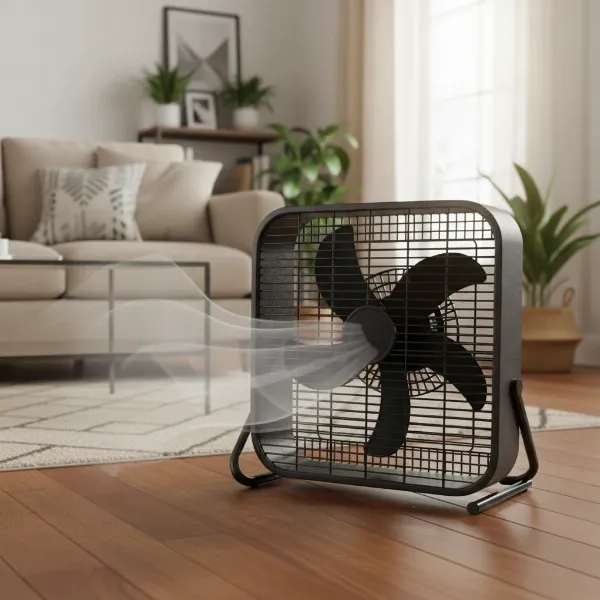 Square box fan with large blades creating powerful airflow for personal and room cooling.
Understanding Box Fan Airflow
|
Our Picks for the Best Electric fan in 2026
As an Amazon Associate I earn from qualifying purchases.
|
||
| Num | Product | Action |
|---|---|---|
| 1 | Dreo Fan for Bedroom, 120° Oscillating Standing Fans, Quiet Floor Fan with DC Motor, 100ft Pedestal Fans for Room, 9 Speeds, 4 modes, 20dB, 120° Manual Vertical, 37-42" Adjustable Height, 9H Timer |

|
| 2 | Lasko 2520 Oscillating Stand Fan,White 16 Inch |
|
| 3 | XPOWER FC-100S Multipurpose 11 Pro Air Circulator Utility Fan with Oscillating Feature |
|
| 4 | Dreo Tower Fan for Bedroom, 25ft/s Velocity Quiet Floor Fan, 90° Oscillating Fans for Indoors with 4 Speeds, 4 Modes, 8H Timer, Standing Fans, Bladeless Fan, Black, Nomad One (DR-HTF007) |
|
| 5 | Dreo Fan for Bedroom, 120° Oscillating Standing Fan, Quiet Floor Fan with DC Motor, Pedestal Fan for Room, 9 Speeds, 4 modes, 20dB, 120° Manual Vertical, 37-42" Adjustable Height, 9H Timer, Black |
|
| 6 | Amazon Basics 16" Pedestal Fan with Remote, Floor Fan, Standing Fan for Bedroom, Living Room, Office, with 3 Speeds, 3 Modes, Timer, Dual-Layered Blades, Adjustable Height, Tilt Head, 60W, Black |
|
| 7 | Amazon Basics Air Circulator Fan, Desk Fan for Bedroom, Home and Office, With 90-Degree Tilt Head, 3 Speed Settings, Lightweight (3 LBS), 35 Watts, Black, 11.1"W x 6.3"D x 10.9"H |
|
| 8 | LEVOIT Tower Fan for Bedroom, 25ft/s Velocity Standing Fan with 28dB Quiet for Sleep, Remoter, 12H Timer, 5 Speeds, 4 Modes, 90° Oscillation for Home, Office, Indoor, Bladeless 36 inch, White |
|
| 9 | Viniper Portable Rechargeable Fan, Small Desk Fan : 3 Speeds & about 8-24 Hours Longer Working, 180 Rotation, Portable Desktop Fan Small but Mighty, Strong Wind (White, Light Black Blade)6.2 Inch |
|
| 10 | 10" Modern Standing Fan for Bedroom, Sleek Oscillating Pedestal Fan, 3-Speed & Height Adjustable Compact Floor Fan for Home Office & Dorm |
|
On average, box fans tend to boast a higher Cubic Feet per Minute (CFM) rating compared to many other portable fans of similar size. This means they are capable of moving a significant volume of air. When directed at a person, this powerful, concentrated airflow creates an instant cooling effect, rapidly dissipating body heat. Their robust design allows them to effectively push air across a room, making them excellent for localized cooling or for creating a strong current to aid in circulation. While not specifically designed for windows, box fans are often adapted for window use to either exhaust stale air or draw in fresh air.
Advantages of Box Fans
The primary advantage of box fans is their incredible portability. Lightweight and easy to move, they can be deployed wherever cooling is needed most – be it a living room, bedroom, garage, or workshop. This versatility allows you to target cooling precisely. Furthermore, box fans are often more cost-effective than specialized window fans, offering substantial airflow without a hefty price tag. Their simple design also makes them adaptable for various creative uses, such as being placed in front of ice packs to create a makeshift air conditioner or even rigged with filters for basic air purification.
Disadvantages and Considerations
Despite their advantages, box fans do come with drawbacks. When used in a window opening, they typically do not fit optimally, leaving gaps around the edges. These gaps can compromise the efficiency of air exchange, allowing outside air, bugs, dust, and pollen to infiltrate the room. This lack of a sealed fit means you might not be maximizing the fan’s potential for ventilation. Another crucial consideration is safety: if a box fan tips over and lies flat, its airflow can become restricted, potentially leading to the motor overheating and posing a fire risk. For window placement, it’s generally recommended to position box fans to blow in rather than out, particularly in multi-story homes. Blowing air out can depressurize a house, potentially causing dangerous backdrafting from chimneys or water heaters, leading to carbon monoxide buildup.
Window Fans: Purpose-Built for Efficient Ventilation
Window fans are distinctly designed with a singular purpose: to integrate seamlessly into window openings to facilitate efficient air exchange between indoors and outdoors. They are the specialists of home ventilation.
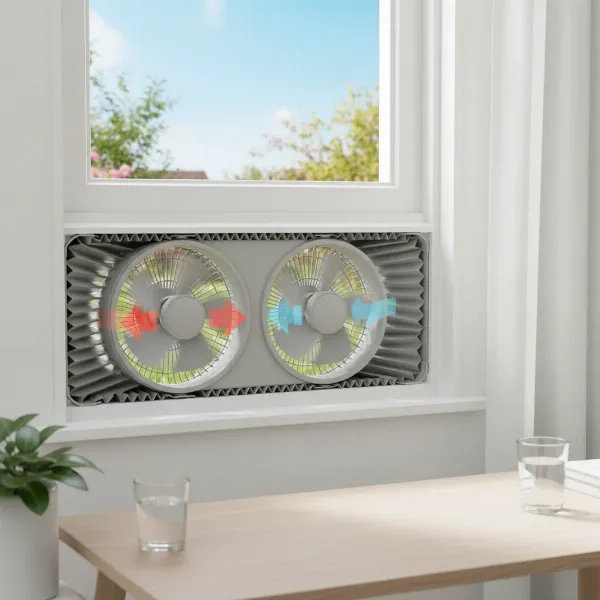 Dual-bladed window fan with expandable side panels perfectly sealed in a modern window frame.
Optimizing Air Exchange with Window Fans
The hallmark of a window fan is its snug fit within a window frame. Unlike box fans, they often feature expandable side panels or a dual-fan design to perfectly seal the opening. This tailored fit is paramount for effective ventilation, ensuring that nearly all the air moved by the fan is either drawn into or expelled from the room, without unnecessary air leakage around the edges. Many window fans also offer reversible airflow, allowing them to switch between intake (pulling fresh air in) and exhaust (pushing stale, warm air out) with the flip of a switch. While they may not always boast the highest raw CFM figures compared to some powerful box fans, their sealed installation and focused airflow make them incredibly efficient at targeted air exchange. Furthermore, they are often designed to operate more quietly than their box fan counterparts, making them suitable for bedrooms or quiet spaces.
Advantages of Window Fans
The most significant benefit of window fans is their secure and sealed fit in windows. This minimizes gaps, effectively blocking out insects, dust, and unwanted outdoor elements while maximizing the efficiency of air movement. Their ability to precisely control the direction of airflow, often with reversible settings, makes them exceptional for creating cross-ventilation or rapidly clearing a room of odors or heat. The quieter operation of many models also contributes to a more peaceful environment.
Disadvantages and Limitations
The main limitation of window fans is their lack of portability. They are generally intended for fixed installation in a window and are not easily moved from room to room like a box fan. Their specialized design means they are primarily useful only when placed in a window, limiting their versatility as a general-purpose portable fan. While excellent for air exchange, a window fan’s direct cooling effect within a room might be less pronounced than a box fan aimed directly at you, as its primary function is to circulate air through the entire space rather than create a focused breeze.
Which Moves More Air? A Deeper Dive into Performance
The question of which fan “moves more air” is more nuanced than a simple CFM comparison. While a box fan might have a higher raw CFM, the effectiveness of air movement depends heavily on the application.
CFM vs. Effective Air Circulation
CFM (Cubic Feet per Minute) is a standard metric indicating the volume of air a fan can move. Generally, box fans tend to have higher CFM ratings, suggesting they can displace more air per minute. However, effective air circulation is not solely about the fan’s power but how efficiently that air is moved through a space or an opening. A powerful box fan crammed into a window might move a lot of air directly through its blades, but if air leaks around the edges, its overall impact on room ventilation is diminished. In contrast, a well-fitted window fan, even with a slightly lower CFM, can be more effective at creating a true air exchange because it seals the opening.
Interestingly, some tests suggest that a fan placed a few feet away from a window can sometimes move as much or even more air through that window than a box fan directly installed in it. This highlights that “thrust” and the ability to move air over a distance, rather than just directly at the fan blades, also play a crucial role in overall air movement effectiveness.
Factors Influencing Airflow Effectiveness
Several factors influence how effectively a fan moves air:
- Room Size and Layout: Larger rooms require more powerful fans or multiple units for effective circulation.
- Fan Placement: Strategic placement, whether in a window (intake or exhaust) or within the room, dramatically impacts performance. Clear any obstructions like curtains or drapes, which can restrict airflow and potentially cause overheating.
- Window Sealing: For window fans, a tight seal is paramount to prevent air leakage and maximize exchange efficiency.
- External Conditions: A natural breeze outside can significantly enhance or even override a fan’s effect. If there’s a strong breeze, simply opening windows might be more effective than using a fan.
Choosing the Right Fan for Your Needs
Deciding between a box fan and a window fan boils down to your primary cooling objective and the specific environment.
Consider Your Space and Goal
- For Direct, Portable Cooling: If your main goal is to cool yourself directly, or to provide general air circulation within a room without relying on a window, a box fan is an excellent choice due to its high airflow and portability.
- For Targeted Room Ventilation/Air Exchange: If you need to efficiently bring fresh air in from outside or exhaust hot, stale air out of a specific room through a window, a window fan is superior. Its ability to create a sealed barrier maximizes effective air exchange.
- For Whole-House Air Movement: A combination approach often works best. Use window fans to create intake and exhaust points, and portable box fans strategically placed within the house to direct air movement and facilitate cross-ventilation.
Key Decision Factors
When making your purchase, consider these points:
- Portability vs. Fixed Placement: Do you need a fan you can move easily, or one dedicated to a window?
- Noise Level Preference: Window fans are often designed to be quieter, a crucial factor for bedrooms.
- Budget: Box fans are generally more budget-friendly.
- Safety: Always consider placement to prevent overheating and follow guidelines for window usage to avoid backdrafting.
Essential Tips for Fan Usage and Maintenance
To ensure your Electric Fan operates effectively and safely for years to come, proper usage and routine maintenance are crucial.
Optimal Placement for Maximum Airflow
For box fans used for general circulation, place them in a corner or strategically to create a wind tunnel effect. If using a box fan in a window, position it to blow in for safety reasons, preventing dangerous backdrafting. For window fans, ensure they are properly sealed in the window frame. To effectively cool a home, create a flow-through ventilation system: place an exhaust fan in an upstairs window to push hot air out, and an intake fan in a downstairs window to pull cool air in. Always clear any drapes, curtains, or other obstructions around the fan to ensure unrestricted airflow and prevent motor overheating.
Safety and Longevity
Regular cleaning is paramount for fan longevity and efficiency. Dust and debris can build up on blades and grilles, reducing airflow and straining the motor. Clean your fan frequently by wiping down the blades and housing. For deeper cleaning, especially for box fans, you might need to unscrew the front grille. Always unplug the fan before cleaning or moving it. Periodically check for any signs of damage to the cord or blades. Older fans, especially those with metal blades and limited protective shrouds, can pose safety risks to children and pets, and are generally less energy-efficient than modern models. Consider replacing very old fans for improved safety and performance.
Where to Purchase Quality Electric Fans
When you’re ready to purchase a fan, reliability is key. Reputable retailers such as major electronics stores, home improvement centers, and trusted online marketplaces are good starting points. Always look for brands with positive reviews and ensure the product comes with a manufacturer’s warranty. Checking for energy efficiency ratings can also help you save on electricity bills in the long run.
Your Electric Fan Buying Guide
Navigating the fan market can be simplified by answering a few core questions before you shop.
What’s Your Budget?
Fan prices vary widely based on type, features, and brand. Determine how much you’re willing to spend to narrow down your options, keeping in mind that a slightly higher investment can sometimes mean better durability or more advanced features.
How Large is Your Room?
The size of your space dictates the power you’ll need. A small personal fan might suffice for a desk, but a large living room will require a powerful box fan or a dual window fan system to make a noticeable difference in airflow.
What Features Do You Need?
Consider features like multiple speed settings, oscillation (for portable fans), a timer for automatic shut-off, a remote control for convenience, or reversible airflow functions for window fans. Prioritize features that align with your specific cooling habits and preferences.
Conclusion
Choosing between a box fan and a window fan ultimately depends on whether you prioritize versatile, direct airflow or efficient, sealed air exchange. Box fans excel in portability and delivering a powerful, immediate breeze, making them ideal for personal cooling and general room circulation. Window fans, with their tailored fit and often reversible functions, are unmatched for effectively ventilating a room, drawing in fresh air, or expelling stale, hot air. Understanding the nuances of CFM versus effective circulation and considering your specific environment will guide you to the perfect solution. By making an informed choice, you can transform your space into a more comfortable and well-ventilated haven.
Which fan will you choose to create your ideal indoor climate this season?
Frequently Asked Questions
Can a box fan be used as a window fan?
Yes, a box fan can be placed in a window to function as a window fan, either pulling air in or pushing it out. However, they typically don’t fit perfectly, leaving gaps that can reduce efficiency and allow insects or dust to enter.
Are window fans more energy efficient?
Window fans are often considered more energy-efficient for ventilating a room because their snug fit maximizes air exchange, meaning less energy is wasted on air leaking around the fan. This targeted ventilation can be more effective than a less-sealed box fan for overall room cooling.
How far should a fan be from a window for best effect?
For optimal air movement, sometimes a fan (even a desk fan) placed a few feet away from a window can be as effective or even more effective than a box fan positioned directly in the window, depending on the fan’s thrust and the room’s layout.
Do fans cool a room or just people?
Fans cool people by accelerating the evaporation of sweat from the skin, creating a wind chill effect. They do not significantly lower the ambient temperature of a room, furniture, or walls, only the perceived temperature on your skin.