Indoor air quality often goes unnoticed, yet it profoundly impacts our health and well-being. From dust and pet dander to pollen and even airborne viruses, countless particles can circulate within our homes, leading to allergies, respiratory issues, and a general feeling of stuffiness. While commercial air purifiers offer a solution, they can often be expensive and sometimes hard to come by, especially during peak pollution events like wildfire seasons. But what if there was an effective, budget-friendly alternative you could build yourself? This comprehensive guide will walk you through creating your own DIY air purifier using a common electric box fan, helping you achieve cleaner, fresher indoor air without breaking the bank.
The Simple Power of the Box Fan: Your DIY Air Purifier Base
The unassuming box fan, a staple in many households for circulating air, holds surprising potential as the core of an effective air purification system. Its straightforward design and powerful airflow make it an ideal candidate for pushing air through filters, trapping harmful particles and dramatically improving indoor air quality. The concept of using electric fans with furnace filters gained significant traction during the COVID-19 pandemic and wildfire seasons, demonstrating a practical and accessible way for individuals to take control of their immediate air environment. Researchers and enthusiasts alike have championed these DIY solutions, proving that simple components can combine to create powerful results.
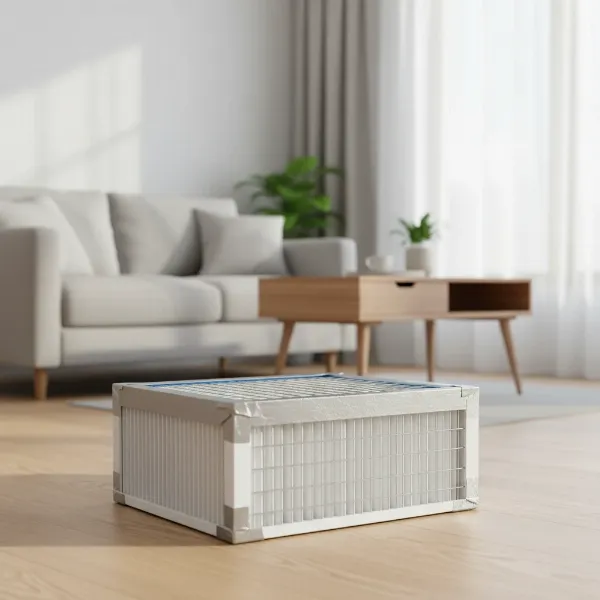 Simple DIY air purifier made from a white box fan and a single pleated furnace filter.
Essential Components for Your DIY Air Purifier
Building your own air purifier is surprisingly simple, requiring just a few key materials readily available at most hardware or home improvement stores. The success of your DIY unit hinges on selecting the right components.
Selecting the Right Box Fan
At the heart of your DIY air purifier is the box fan.
- Size: A standard 20-inch box fan is generally recommended due to its balance of airflow and compatibility with readily available furnace filters. Ensure the fan is in good working condition, with no damaged blades or electrical cords.
- Condition: Opt for newer models if possible, as they often come with improved motor designs that are less prone to overheating, enhancing overall safety.
|
Our Picks for the Best Electric Fan in 2026
As an Amazon Associate I earn from qualifying purchases.
|
||
| Num | Product | Action |
|---|---|---|
| 1 | Amazon Basics 16" Pedestal Fan with Remote, Floor Fan, Standing Fan for Bedroom, Living Room, Office, with 3 Speeds, 3 Modes, Timer, Dual-Layered Blades, Adjustable Height, Tilt Head, 60W, Black |

|
| 2 | 10" Modern Standing Fan for Bedroom, Sleek Oscillating Pedestal Fan, 3-Speed & Height Adjustable Compact Floor Fan for Home Office & Dorm |
|
| 3 | Viniper Portable Rechargeable Fan, Small Desk Fan : 3 Speeds & about 8-24 Hours Longer Working, 180 Rotation, Portable Desktop Fan Small but Mighty, Strong Wind (White, Light Black Blade)6.2 Inch |
|
| 4 | Dreo Tower Fan for Bedroom, 25ft/s Velocity Quiet Floor Fan, 90° Oscillating Fans for Indoors with 4 Speeds, 4 Modes, 8H Timer, Standing Fans, Bladeless Fan, Black, Nomad One (DR-HTF007) |
|
| 5 | Lasko 2520 Oscillating Stand Fan,White 16 Inch |
|
| 6 | XPOWER FC-100S Multipurpose 11 Pro Air Circulator Utility Fan with Oscillating Feature |
|
| 7 | Dreo Fan for Bedroom, 120° Oscillating Standing Fans, Quiet Floor Fan with DC Motor, 100ft Pedestal Fans for Room, 9 Speeds, 4 modes, 20dB, 120° Manual Vertical, 37-42" Adjustable Height, 9H Timer |
|
| 8 | Dreo Fan for Bedroom, 120° Oscillating Standing Fan, Quiet Floor Fan with DC Motor, Pedestal Fan for Room, 9 Speeds, 4 modes, 20dB, 120° Manual Vertical, 37-42" Adjustable Height, 9H Timer, Black |
|
| 9 | LEVOIT Tower Fan for Bedroom, 25ft/s Velocity Standing Fan with 28dB Quiet for Sleep, Remoter, 12H Timer, 5 Speeds, 4 Modes, 90° Oscillation for Home, Office, Indoor, Bladeless 36 inch, White |
|
| 10 | Amazon Basics Air Circulator Fan, Desk Fan for Bedroom, Home and Office, With 90-Degree Tilt Head, 3 Speed Settings, Lightweight (3 LBS), 35 Watts, Black, 11.1"W x 6.3"D x 10.9"H |
|
Choosing the Correct Air Filters (MERV Rating Explained)
The effectiveness of your air purifier largely depends on the filters you use. This is where the Minimum Efficiency Reporting Value, or MERV rating, comes into play.
- What is MERV? MERV is a standard rating system that indicates an air filter’s ability to capture particles between 0.3 and 10 microns. The higher the MERV rating, the more efficiently the filter captures smaller particles.
- Recommended Ratings:
- MERV 8-10: Good for general household pollutants like dust, pollen, and pet dander.
- MERV 11-13: Highly recommended for addressing finer particles such as wildfire smoke, bacteria, mold spores, and many common allergens and viruses. For optimal air purification in a DIY setup, a MERV 13 filter is often considered the sweet spot, offering excellent filtration without overly restricting airflow for most box fans.
- Size: Most DIY box fan purifiers use 20″x20″x1″ or 2″ pleated furnace filters, as they perfectly match the dimensions of standard box fans.
Additional Materials for Assembly
Beyond the fan and filters, you’ll need a few common household items to secure and seal your purifier.
- Duct Tape: Essential for creating a tight seal between the filters and the fan, preventing air from bypassing the filtration media. Choose a high-quality, durable tape.
- Optional Cardboard: Cardboard can be useful for creating shrouds to optimize airflow or for building structural support in multi-filter designs. Scissors or a utility knife will be needed for cutting.
Step-by-Step Guide: Building Your DIY Box Fan Air Purifier
There are a couple of popular designs for DIY box fan air purifiers, ranging from a simple single-filter setup to the more robust Corsi-Rosenthal Box.
The Basic Single-Filter Setup
This is the quickest and easiest way to build a functional air purifier, ideal for small rooms or immediate needs.
- Prepare Your Fan: Lay your box fan flat on a stable surface, with the intake side (the side that pulls air in, usually the back with the fan motor exposed) facing up.
- Position the Filter: Place one 20″x20″ furnace filter directly over the intake side of the box fan. Ensure the airflow arrow on the filter points towards the fan (into the fan).
- Secure and Seal: Use duct tape to firmly attach the filter to all four sides of the fan’s frame. It’s crucial to create a complete, airtight seal around the entire perimeter of the filter to ensure all air passes through the filter media, not around it.
Constructing the Corsi-Rosenthal Box (Multi-Filter Design)
Named after its creators, Richard Corsi and Jim Rosenthal, this design offers significantly more filtration surface area and is highly effective for larger rooms or areas with higher pollution levels.
- Gather Filters: You’ll need four (or five, for an optional bottom filter) 20″x20″ MERV 13 furnace filters.
- Form the Cube: Arrange four filters to form the sides of a cube. Crucially, ensure that the airflow arrows on all four filters point inwards towards the center of where the fan will be placed.
- Secure the Sides: Using duct tape, meticulously tape the edges of the filters together where they meet, creating a sturdy cube structure. Ensure every seam is sealed to prevent air leakage.
- Add the Top (Fan): Place the box fan on top of the filter cube, with the fan’s output side (the side that blows air out) facing upwards. The fan should sit snugly on the top opening of the cube.
- Seal the Fan: Tape the fan securely to the top edges of the filter cube, sealing all remaining gaps.
- Optional Bottom Filter: For enhanced filtration and structural integrity, you can add a fifth filter to the bottom of the cube, again ensuring the airflow arrow points inwards and all edges are sealed with tape. If not using a fifth filter, use a piece of cardboard to seal the bottom.
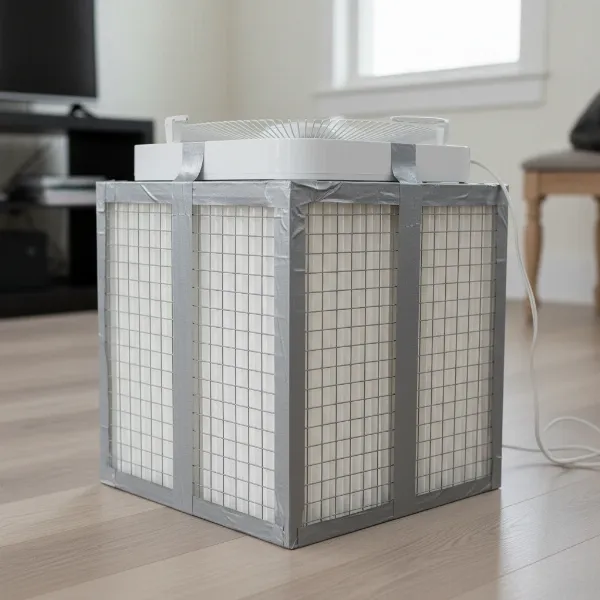 A multi-filter Corsi-Rosenthal Box DIY air purifier with four MERV 13 filters forming a cube and a box fan on top.
“The Corsi-Rosenthal Box is a game-changer for accessible air purification, demonstrating how readily available parts can deliver powerful results akin to much more expensive commercial units.” – Dr. Richard Corsi, Engineer and co-creator
Optimizing Your DIY Air Purifier: Performance and Safety
Once built, understanding how to best operate and ensure the safety of your DIY air purifier is essential for maximizing its benefits.
Enhancing Filtration and Airflow
- Placement Matters: Position your air purifier in the center of the room or in an area with good air circulation to effectively draw in and clean the air. Avoid placing it directly against walls or in corners, which can hinder airflow.
- Consider a Shroud: Research from the EPA suggests that adding a simple cardboard shroud around the fan’s outlet can improve performance by blocking recirculating airflow past the fan blades. This can be as simple as a piece of cardboard with a circular cutout taped to the fan’s exhaust side.
- Run Time: For continuous air cleaning, running your unit consistently on a medium setting is often more effective than intermittent high-speed operation.
Important Safety Considerations
While DIY air purifiers are generally safe when constructed correctly, it’s vital to be aware of potential risks.
- Supervision: Never leave your DIY filter unattended for prolonged periods, especially overnight or when you leave your home.
- Filter Condition: Do not use damaged, wet, or excessively dirty filters, as this can strain the fan motor or introduce moisture into the electrical components.
- Clearance: Keep the fan and filter unit clear of obstructions, flammable materials, children, and pets.
- Motor Strain: Box fans are not specifically designed to operate against the resistance of dense air filters. While many users report no issues, continuously running a fan with a high MERV filter could potentially lead to motor strain and overheating. Using newer, good-quality fans and ensuring adequate airflow are key precautions. The U.S. Consumer Product Safety Commission has advised caution when using box fans in ways other than their intended design.
- Seal Everything: Any gaps in your taping job mean air bypasses the filter, reducing effectiveness and potentially straining the fan more. Double-check all seals.
Maintaining Your DIY Air Purifier for Longevity and Effectiveness
Proper maintenance ensures your DIY air purifier continues to deliver clean air efficiently and extends the lifespan of your unit.
When and How to Replace Filters
The frequency of filter replacement depends on usage and the level of indoor air pollution.
- General Rule: For typical household use, replace MERV 8-13 filters every 60-90 days.
- High Pollution: During periods of high pollution, such as wildfire smoke events, you may need to replace filters as frequently as every 30 days or even sooner.
- Signs of a Dirty Filter: Look for visible discoloration or buildup on the filter surface, decreased airflow from the fan, or an increase in fan noise as the motor works harder.
- Replacement Process: Always unplug the fan before removing old filters. Wear gloves and a mask to avoid inhaling captured particulates when handling dirty filters.
Cleaning Your Box Fan
Regular cleaning of the fan itself is important to maintain performance.
- Frequency: At each filter change, or every few months, wipe down the fan blades and grilles.
- Method: Unplug the fan. Use a damp cloth or a vacuum cleaner with a brush attachment to gently remove dust buildup from the fan blades and protective grilles. Do not submerge the fan in water.
Maximizing the Lifespan of Your Unit
- Regular Checks: Periodically inspect the fan and filter assembly for any loose tape, damage, or excessive motor heat.
- Proper Storage: If you plan to store your DIY air purifier for an extended period, remove the filters and store the fan in a clean, dry place to prevent dust accumulation.
Sourcing Materials for Your DIY Air Purifier
Finding the components for your DIY air purifier is straightforward.
- Box Fans: Widely available at general merchandise stores, electronics retailers, and online marketplaces. Look for sales to get the best value.
- Furnace Filters: Found in the HVAC section of home improvement stores, hardware stores, and also online. Buying in multi-packs can often be more economical.
- Duct Tape and Cardboard: These can be purchased from any hardware store, craft store, or even some grocery stores.
When purchasing, consider looking for Energy Star certified box fans for potentially better energy efficiency, although the primary cost will be the filters.
DIY Air Purifier Buying Guide: What to Consider
Deciding to build a DIY air purifier is a practical step towards improving your indoor environment. To make the best choices, consider these factors:
What is Your Budget?
DIY air purifiers are inherently cost-effective, typically ranging from $30-$70 for the initial build, depending on the fan and filters chosen. This is significantly less than most commercial HEPA units, which can cost hundreds of dollars. Factor in the recurring cost of filter replacements.
What Room Size Are You Targeting?
The size and number of filters, along with the fan’s speed, will influence the Clean Air Delivery Rate (CADR) and thus the effective room size. A single-filter setup is suitable for smaller rooms (e.g., bedrooms), while a Corsi-Rosenthal Box can effectively clean the air in medium to large living spaces.
What Level of Filtration Do You Need?
Your specific concerns will guide your filter choice:
- General Dust/Pollen: A MERV 8-10 filter is a good starting point.
- Allergies, Pet Dander, Mild Smoke: Step up to a MERV 11 filter.
- Wildfire Smoke, Viruses, Bacteria, Severe Allergies: A MERV 13 filter offers superior particulate capture. Remember, the higher the MERV, the more resistance to airflow, which the fan must overcome.
Conclusion
Creating your own DIY air purifier with a box fan is a testament to ingenuity and a powerful way to enhance the air quality in your home. It’s an accessible, cost-effective solution that empowers you to tackle common indoor pollutants, from irritating dust and allergens to more serious threats like wildfire smoke and airborne pathogens. By following simple instructions and prioritizing safety, you can construct a device that rivals many commercial units in effectiveness, proving that clean air doesn’t have to come with a hefty price tag. Isn’t it time you took a breath of fresh, purified air in your own home?
Frequently Asked Questions
Is a DIY box fan air purifier truly effective?
Yes, studies have shown that DIY box fan air purifiers, especially the Corsi-Rosenthal Box design with MERV 13 filters, can be highly effective at removing fine particulate matter like smoke, dust, pollen, and even airborne viruses, often performing comparably to smaller commercial units.
What MERV rating is best for a DIY air purifier?
For optimal performance against a wide range of pollutants, including smoke, allergens, and viruses, a MERV 13 filter is generally recommended. For basic dust and pollen removal, MERV 8-10 can be sufficient.
How often should I change the filters in my DIY air purifier?
Filters should typically be changed every 60-90 days under normal usage. During periods of high pollution, such as wildfire smoke events, you may need to replace them as frequently as every 30 days or when visible dust buildup or reduced airflow is noticed.
Are DIY box fan air purifiers safe to use continuously?
While many users operate them continuously with proper precautions, it’s important to monitor the unit for any signs of overheating or motor strain, and never leave it unattended for very long periods, especially overnight.