In the relentless battle against rising temperatures, the humble electric fan stands as an indispensable ally. But with a myriad of options available, choosing the right one can feel overwhelming. At the heart of many cooling dilemmas lies a fundamental question: should you opt for an oscillating fan that sweeps the air or a stationary model that delivers a focused breeze? Understanding the core differences, along with their respective advantages and disadvantages, is key to selecting the perfect fan for your personal comfort and space.
Understanding Electric Fans: A Brief Overview
Before diving into the specifics, it’s essential to clarify what an electric fan actually does. Contrary to popular belief, fans do not actively cool the air in a room like an air conditioner. Instead, they create a wind-chill effect by moving air across your skin, accelerating the evaporation of sweat and making you feel cooler. This evaporative cooling is why a fan pointed directly at you feels so refreshing on a hot day. In fact, fans consume energy and their motors add a negligible amount of heat to a room, meaning they don’t actually lower the ambient temperature.
The primary distinction between oscillating and stationary fans lies in their airflow distribution. Oscillating fans are designed with a pivoting mechanism that allows the fan head to move back and forth, typically covering an arc of up to 90 degrees. This sweeping motion distributes air across a wider area. Stationary fans, on the other hand, direct airflow in a single, fixed direction, concentrating the breeze to one specific spot. Each design serves a distinct purpose, offering unique benefits depending on your cooling needs and environment.
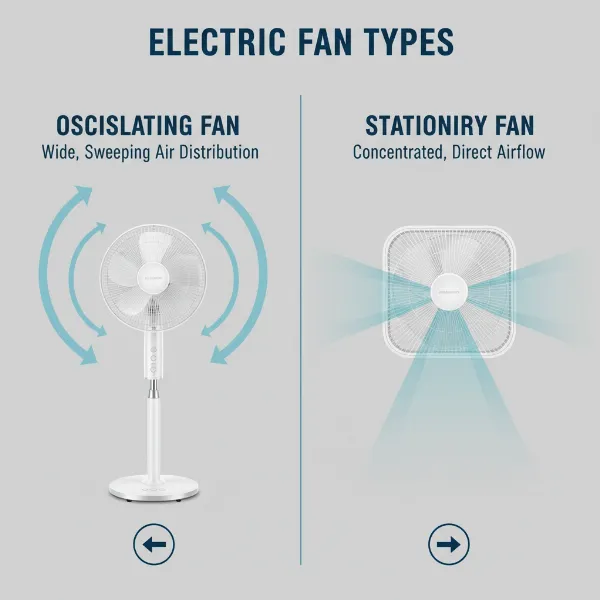 Infographic comparing air distribution of oscillating fan (wide sweep) and stationary fan (focused stream).
Oscillating Fans: Spreading the Breeze
Oscillating fans are a popular choice for many households and offices due to their ability to circulate air broadly. They leverage a motor-driven mechanism that gently sweeps the fan head from side to side, ensuring air movement isn’t confined to a single spot.
Pros of Oscillating Fans
- Wide Area Coverage & Improved Air Circulation: One of the main advantages is their ability to distribute cool air across a larger area, reducing stagnant pockets of warm air. This makes them ideal for cooling living rooms, bedrooms, or offices where multiple people might be present.
- Versatility in Room Types: Oscillating fans are well-suited for almost any space. In living rooms, a tall tower or pedestal model can circulate air effectively, even with several occupants. Smaller desk models offer comfort in home offices, while their constant airflow in kitchens can help dispel heat and odors.
- Energy Efficiency: When compared to air conditioning units, oscillating fans consume significantly less electricity. They can be strategically used to supplement an AC system, allowing you to raise your thermostat a few degrees while maintaining comfort, leading to lower energy bills.
- Consistent Comfort: The sweeping motion provides a more consistent, refreshing breeze across a wider personal zone, which can make the area feel cooler than the actual indoor temperature. Some models even feature adjustable speed settings, allowing you to tailor the airflow intensity to your preference.
|
Our Picks for the Best Electric Fan in 2026
As an Amazon Associate I earn from qualifying purchases.
|
||
| Num | Product | Action |
|---|---|---|
| 1 | 10" Modern Standing Fan for Bedroom, Sleek Oscillating Pedestal Fan, 3-Speed & Height Adjustable Compact Floor Fan for Home Office & Dorm |

|
| 2 | Lasko 2520 Oscillating Stand Fan,White 16 Inch |
|
| 3 | Dreo Tower Fan for Bedroom, 25ft/s Velocity Quiet Floor Fan, 90° Oscillating Fans for Indoors with 4 Speeds, 4 Modes, 8H Timer, Standing Fans, Bladeless Fan, Black, Nomad One (DR-HTF007) |
|
| 4 | Amazon Basics 16" Pedestal Fan with Remote, Floor Fan, Standing Fan for Bedroom, Living Room, Office, with 3 Speeds, 3 Modes, Timer, Dual-Layered Blades, Adjustable Height, Tilt Head, 60W, Black |
|
| 5 | XPOWER FC-100S Multipurpose 11 Pro Air Circulator Utility Fan with Oscillating Feature |
|
| 6 | Dreo Fan for Bedroom, 120° Oscillating Standing Fans, Quiet Floor Fan with DC Motor, 100ft Pedestal Fans for Room, 9 Speeds, 4 modes, 20dB, 120° Manual Vertical, 37-42" Adjustable Height, 9H Timer |
|
| 7 | LEVOIT Tower Fan for Bedroom, 25ft/s Velocity Standing Fan with 28dB Quiet for Sleep, Remoter, 12H Timer, 5 Speeds, 4 Modes, 90° Oscillation for Home, Office, Indoor, Bladeless 36 inch, White |
|
| 8 | Amazon Basics Air Circulator Fan, Desk Fan for Bedroom, Home and Office, With 90-Degree Tilt Head, 3 Speed Settings, Lightweight (3 LBS), 35 Watts, Black, 11.1"W x 6.3"D x 10.9"H |
|
| 9 | Dreo Fan for Bedroom, 120° Oscillating Standing Fan, Quiet Floor Fan with DC Motor, Pedestal Fan for Room, 9 Speeds, 4 modes, 20dB, 120° Manual Vertical, 37-42" Adjustable Height, 9H Timer, Black |
|
| 10 | Viniper Portable Rechargeable Fan, Small Desk Fan : 3 Speeds & about 8-24 Hours Longer Working, 180 Rotation, Portable Desktop Fan Small but Mighty, Strong Wind (White, Light Black Blade)6.2 Inch |
|
Cons of Oscillating Fans
While highly versatile, oscillating fans do have some limitations. Their broad sweep means that the airflow directed at a single person is less constant and intense compared to a stationary fan, as the breeze moves away periodically. Additionally, the mechanical components responsible for oscillation, though generally robust, represent an extra moving part that could, theoretically, be a point of wear over time. If not regularly cleaned, these fans can also circulate dust and allergens present in the air, which isn’t ideal for allergy sufferers.
Stationary Fans: Focused Power
In contrast to their oscillating counterparts, stationary fans are engineered to deliver a powerful, unwavering stream of air in a single direction. This design offers a different set of advantages, particularly for specific cooling scenarios.
Pros of Stationary Fans
- Direct, Intense Cooling for Individuals: The primary benefit of a stationary fan is its ability to provide strong, concentrated airflow directly to a person or a very specific spot. If you’re working at a desk, sleeping in bed, or need immediate personal cooling, a stationary fan excels at creating a powerful, targeted breeze.
- Targeted Ventilation: Stationary fans are highly effective for creating cross-breeze ventilation. Placed in a window, they can efficiently pull in cooler air from outside (especially in the evenings) or push out warm, stale air from a room. This method can significantly improve overall air quality and temperature balance.
- Simplicity and Potential Quietness: With fewer moving parts, many stationary fans have a simpler design, which can sometimes translate to quieter operation, though this varies greatly by model and motor quality. They are often more straightforward in their functionality.
- Ideal for Specific Tasks: Beyond personal cooling, the focused airflow of a stationary fan can be useful for tasks like drying a small damp area, accelerating paint drying, or quickly clearing smoke from a localized space when combined with an open window.
Cons of Stationary Fans
The very feature that makes stationary fans effective for targeted cooling—their fixed direction—is also their main drawback.
- Limited Coverage for Multiple People/Large Rooms: A stationary fan is not designed for whole-room cooling or for providing comfort to multiple occupants simultaneously. Its concentrated airflow means that only the area directly in front of it benefits from the breeze, leaving other parts of the room unaffected.
- “Hot Spots” Outside Direct Airflow: This limited coverage can create noticeable “hot spots” in a room, where air remains stagnant and warm, making the overall environment less comfortable for everyone not directly in the fan’s path.
- Safety Concerns: Many traditional stationary fans, particularly pedestal or box fans, feature exposed blades that can pose a safety risk to curious children and pets. This necessitates careful placement and consideration for homes with young ones.
- Aesthetic Considerations: While some stationary fans are designed with modern aesthetics, many traditional models can appear bulkier or less sleek compared to some contemporary oscillating tower fans, potentially clashing with minimalist decor.
Choosing Your Fan: Factors to Consider
Deciding between an oscillating and a stationary fan boils down to understanding your specific needs. Here are the critical factors to weigh:
Room Size and Occupancy
For larger rooms or spaces where multiple people need cooling, an oscillating fan is generally the superior choice due to its wide area coverage. If you need intense, direct cooling for just yourself in a smaller area, a stationary fan will be more effective.
Cooling Preference
Do you prefer a gentle, sweeping breeze that moves around the room, or a powerful, continuous blast of air aimed directly at you? Your personal preference for airflow distribution will heavily influence your decision.
Noise Level
Fans, especially at higher speeds, can generate noise. If you plan to use the fan in a bedroom, office, or any quiet environment, checking the decibel rating and opting for a model known for quiet operation is crucial. Modern fans, both oscillating and stationary, are increasingly designed with noise reduction in mind.
Energy Efficiency
While all fans are more energy-efficient than air conditioners, some models are designed to optimize power consumption. Look for features like multiple speed settings and timers, which allow you to tailor usage and reduce electricity bills.
Safety and Design
Consider who will be in the room. If you have young children or pets, a fan with a fully enclosed design (like some tower fans or bladeless options) might be safer than one with exposed blades. Additionally, the fan’s aesthetic should complement your room’s decor.
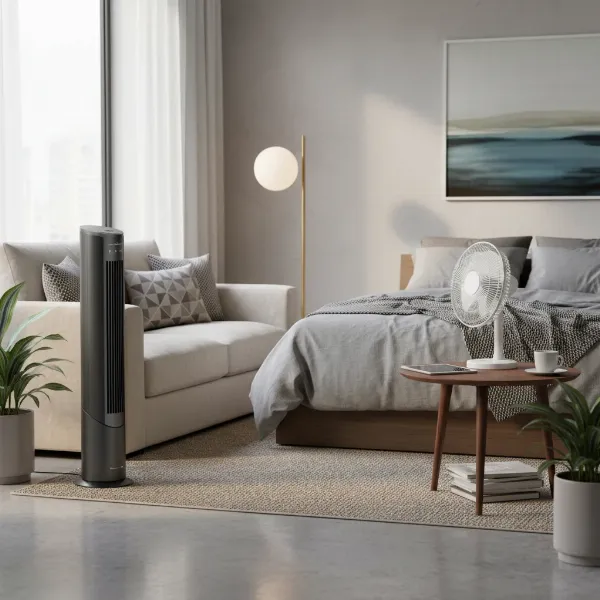 Two different electric fans in a stylish home: an oscillating tower fan and a small stationary desk fan.
Maximizing Fan Efficiency: Tips for Both Types
Regardless of whether you choose an oscillating or stationary model, proper usage and maintenance can significantly enhance its performance and longevity.
Strategic Placement
The location of your fan can make a big difference. To create effective cross-ventilation, place a fan near an open window, ideally facing into the room when the outdoor air is cooler than indoors (often in the evenings). If it’s hotter outside, angle the fan to push warm indoor air out. Ensure the fan’s airflow isn’t obstructed by curtains or furniture.
Regular Cleaning
Dust and debris can accumulate on fan blades and grills, reducing airflow and efficiency, and potentially circulating allergens. Make it a habit to clean your fan regularly, especially during seasons of heavy use. Unplug the fan, then wipe down the grill and blades. Many models allow you to easily remove the front grill for a more thorough cleaning.
Combining with Other Cooling Methods
Fans work wonders in conjunction with other cooling strategies. Running an oscillating fan with your air conditioning can help distribute cooled air more evenly, potentially allowing you to set your AC thermostat higher and save energy. For an extra burst of cool, placing a bowl of ice or a damp cloth in front of a stationary fan can create a refreshing, chilled mist.
Safety Practices
Always place your fan on a stable, level surface to prevent it from wobbling or tipping over, especially important for pedestal models. Unplug the fan when cleaning or when not in use for extended periods. While convenient, leaving a fan running continuously overnight might not be necessary, as fans cool people, not rooms. Some people also find constant airflow can dry out skin or nasal passages. If needed, use a fan with a timer to set it to turn off after a few hours.
Expert Insights: When to Pick Which Fan
“An oscillating fan is the most effective way to distribute cool air throughout the whole room and increase air circulation, which in turn helps bring the overall temperature of the room down,” explains Jemma Pendlebury, product manager at Russell Hobbs. “This is particularly handy when you’re attempting to cool down a whole room, the room feels stuffy, or there’s more than one person in the space.”
Conversely, a stationary fan excels when intense, direct cooling is required for a singular focus. If you’re battling the heat while cooking in a kitchen or need immediate relief at your workstation, a powerful stationary fan pointed directly at you offers an unmatched personalized breeze. It’s the go-to for localized relief and highly effective directional air movement.
Conclusion
Choosing between an oscillating and a stationary fan ultimately depends on your specific cooling goals and the environment you’re trying to cool. Oscillating fans are champions of wide-area air circulation, perfect for shared spaces and general room comfort. Stationary fans, on the other hand, deliver focused, intense cooling, ideal for personal relief or targeted ventilation. By considering your room size, occupancy, cooling preferences, and practical needs, you can make an informed decision that ensures optimal comfort. Which type of fan will be your ultimate cooling companion this season?
Frequently Asked Questions
Are oscillating fans better for cooling a room?
Oscillating fans are better at distributing air across a larger area, which makes the room feel cooler and fresher by preventing stagnant air. However, no fan actively lowers the ambient air temperature; they cool people by facilitating sweat evaporation.
Do fans actually cool the air?
No, fans do not actually cool the air in a room. They work by creating airflow, which helps cool people through the evaporative effect of moving air across the skin. The fan’s motor even adds a slight amount of heat to the room.
How can I make my fan more effective?
To maximize effectiveness, strategically place your fan near an open window to draw in cooler outside air or push out warm air. Ensure the airflow is unobstructed. For an added cooling boost, place a bowl of ice or a damp cloth in front of the fan so the breeze passes over it.
Is it okay to leave a fan on all night?
While many people leave fans on overnight for comfort, it’s generally not recommended by safety organizations to leave them running unattended or while you’re out. Some also find continuous airflow can dry out skin or nasal passages. Using a fan with a timer can be a good compromise.