Is your ceiling fan doing all it can to keep your home comfortable and energy-efficient year-round? Many homeowners overlook a simple yet powerful feature: the ability to change your ceiling fan’s direction seasonally. This small adjustment can make a significant difference in how you experience your indoor environment, helping you stay cool in summer and warm in winter while potentially lowering your utility bills. Understanding the science behind ceiling fan rotation and implementing the correct settings for each season is key to unlocking its full potential.
Ceiling Fan Basics: Understanding Airflow and Seasons
Electric fans, particularly ceiling fans, are ingenious devices designed to manipulate air movement in a room. Far from just decorative fixtures, they play a crucial role in temperature regulation by creating a perceived change in temperature rather than actually altering the air temperature itself. The effectiveness of a ceiling fan hinges on its direction of rotation, which allows it to either push air down or pull it up, leveraging the natural principles of heat distribution.
The fundamental science at play is simple: warm air rises, and cool air sinks. This phenomenon, known as thermal stratification, means that in any enclosed space, warmer air tends to accumulate near the ceiling, while cooler air settles closer to the floor. By adjusting your ceiling fan’s direction, you can actively work with or against this natural airflow to enhance comfort.
Summer Setting: Counter-Clockwise for a Cooling Breeze
|
Our Picks for the Best Electric fan in 2026
As an Amazon Associate I earn from qualifying purchases.
|
||
| Num | Product | Action |
|---|---|---|
| 1 | 10" Modern Standing Fan for Bedroom, Sleek Oscillating Pedestal Fan, 3-Speed & Height Adjustable Compact Floor Fan for Home Office & Dorm |

|
| 2 | Lasko 2520 Oscillating Stand Fan,White 16 Inch |
|
| 3 | Amazon Basics 16" Pedestal Fan with Remote, Floor Fan, Standing Fan for Bedroom, Living Room, Office, with 3 Speeds, 3 Modes, Timer, Dual-Layered Blades, Adjustable Height, Tilt Head, 60W, Black |
|
| 4 | Viniper Portable Rechargeable Fan, Small Desk Fan : 3 Speeds & about 8-24 Hours Longer Working, 180 Rotation, Portable Desktop Fan Small but Mighty, Strong Wind (White, Light Black Blade)6.2 Inch |
|
| 5 | Amazon Basics Air Circulator Fan, Desk Fan for Bedroom, Home and Office, With 90-Degree Tilt Head, 3 Speed Settings, Lightweight (3 LBS), 35 Watts, Black, 11.1"W x 6.3"D x 10.9"H |
|
| 6 | Dreo Fan for Bedroom, 120° Oscillating Standing Fan, Quiet Floor Fan with DC Motor, Pedestal Fan for Room, 9 Speeds, 4 modes, 20dB, 120° Manual Vertical, 37-42" Adjustable Height, 9H Timer, Black |
|
| 7 | Dreo Tower Fan for Bedroom, 25ft/s Velocity Quiet Floor Fan, 90° Oscillating Fans for Indoors with 4 Speeds, 4 Modes, 8H Timer, Standing Fans, Bladeless Fan, Black, Nomad One (DR-HTF007) |
|
| 8 | Dreo Fan for Bedroom, 120° Oscillating Standing Fans, Quiet Floor Fan with DC Motor, 100ft Pedestal Fans for Room, 9 Speeds, 4 modes, 20dB, 120° Manual Vertical, 37-42" Adjustable Height, 9H Timer |
|
| 9 | XPOWER FC-100S Multipurpose 11 Pro Air Circulator Utility Fan with Oscillating Feature |
|
| 10 | LEVOIT Tower Fan for Bedroom, 25ft/s Velocity Standing Fan with 28dB Quiet for Sleep, Remoter, 12H Timer, 5 Speeds, 4 Modes, 90° Oscillation for Home, Office, Indoor, Bladeless 36 inch, White |
|
When the mercury rises and you’re battling the summer heat, your ceiling fan blades should rotate counter-clockwise. From a vantage point directly beneath the fan, the blades will appear to move from the top-left to the bottom-right. This counter-clockwise motion creates a powerful downdraft, pushing a column of air straight down into the room.
The result is a noticeable “wind chill” effect. This breeze accelerates the evaporation of moisture from your skin, making you feel cooler, even if the room’s ambient temperature remains the same. This allows you to set your air conditioning thermostat a few degrees higher—some experts suggest as much as 4°F—without sacrificing comfort. By reducing your reliance on energy-intensive AC, you can achieve substantial savings on your cooling costs. For optimal cooling, operate your fan at a medium to high speed during these warmer months.
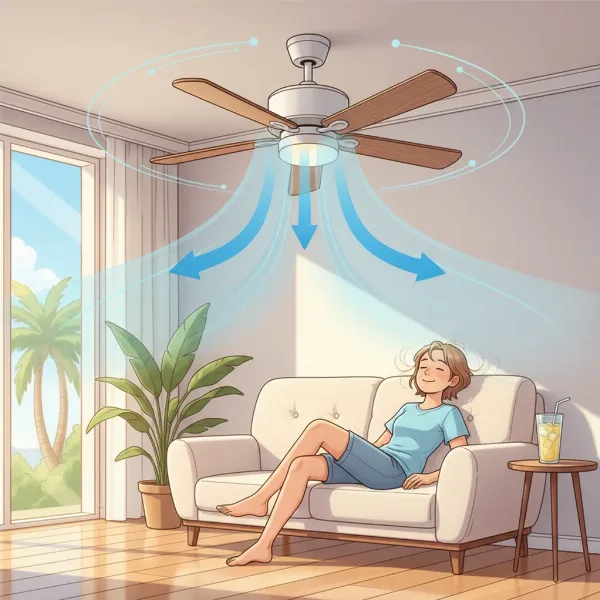 Ceiling fan spinning counter-clockwise, creating a cooling downdraft, making a person feel cool in summer.
Winter Setting: Clockwise for Heat Redistribution
As colder weather sets in, the goal shifts from cooling to warmth. In winter, you’ll want your ceiling fan blades to rotate clockwise. When looking up from below, the blades will move from the top-right to the bottom-left. This clockwise rotation creates an updraft, gently pulling cooler air from below upwards towards the ceiling.
This upward movement displaces the warm air that naturally accumulates at the ceiling, pushing it down along the walls and back into the living space. The key here is gentle circulation; you shouldn’t feel a direct breeze. This process effectively redistributes the heat generated by your furnace or heating system, eliminating cold spots and evening out the room’s temperature. By circulating warm air more efficiently, you can often lower your thermostat by 2-3°F and still feel comfortable, potentially saving up to 15% on heating costs. Always run your ceiling fan at a low speed during winter to avoid creating an unwanted chilling effect.
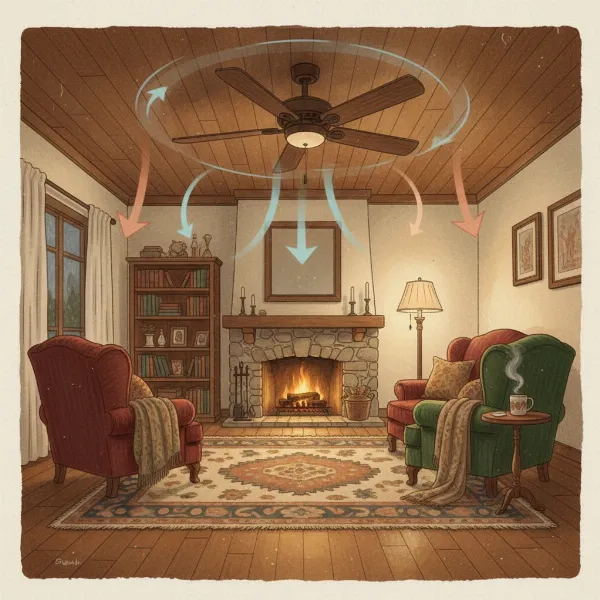 Ceiling fan rotating clockwise, gently pulling warm air up to redistribute heat downwards in a cozy winter room.
Step-by-Step Guide to Changing Your Ceiling Fan Direction
Changing your ceiling fan’s direction is a quick and straightforward task that anyone can accomplish. It’s a small effort that yields big benefits for your comfort and energy bills.
Safety First: Preparing for the Switch
Before you begin, safety is paramount. Always ensure the fan is completely powered off and that the blades have come to a full stop. Never attempt to change the direction while the fan is still moving. Use a sturdy step stool or ladder to safely reach the fan motor housing without stretching or losing balance. Your safety is worth the few extra seconds of preparation.
Locating the Reversing Switch
Most ceiling fans are equipped with a small, discreet reversing switch located on the motor housing, often positioned just above the blades. This switch can be a tiny lever that slides up or down, or horizontally from left to right.
- Traditional Fans: Look for a small switch on the body of the fan, typically near where the blades connect to the motor.
- Pull Chain Fans: Some older models with pull chains for speed control may have a reversing switch on the motor housing that needs to be manually toggled.
- Remote-Controlled Fans: Many modern fans with remote controls offer a dedicated button for changing direction, eliminating the need to physically reach the fan.
- Smart Fans: The latest smart ceiling fans can often be controlled via a smartphone app or voice commands, providing the ultimate convenience for seasonal adjustments.
If you can’t find a switch, check your fan’s manual. In rare cases, very old models might not have a reversible motor.
Flipping the Switch
Once you’ve located the switch, simply slide it to the opposite position. There’s no “right” or “left” default; it simply reverses the motor’s spin. After flipping the switch, step down from your ladder, turn the fan back on, and observe the blade rotation.
To confirm the change:
- For summer (counter-clockwise): You should feel a distinct downward breeze directly beneath the fan.
- For winter (clockwise): You should feel no direct breeze, as the air is being pulled upwards and redistributed along the walls.
Maximizing Energy Savings and Comfort Year-Round
The simple act of adjusting your ceiling fan’s direction can be a cornerstone of an energy-efficient home strategy. It’s a low-cost, high-impact change that complements your existing heating and cooling systems.
The Impact on Your Energy Bills
Integrating ceiling fans into your climate control strategy can lead to significant energy bill reductions. While a ceiling fan itself consumes minimal electricity (around 50 watts), it allows you to reduce the workload of your much more energy-intensive HVAC systems. For instance, a central air conditioning unit can consume around 3,500 watts. By enabling you to raise your AC thermostat by a few degrees in summer, or lower your heater thermostat in winter, ceiling fans help conserve energy without compromising comfort. This synergy can translate to savings of up to 15% on your heating costs alone, making it a truly smart financial move for your household.
Optimizing for Different Room Types
The ideal ceiling fan setup can vary slightly depending on the room’s characteristics:
- High or Vaulted Ceilings: In rooms with high ceilings, thermal stratification is more pronounced, with a larger volume of warm air trapped above. For these spaces, the winter clockwise setting at a low speed is particularly effective in pushing that trapped warm air down to the living area. While some suggest continuous counter-clockwise operation for general circulation in very large, open spaces, adhering to seasonal changes generally provides the best energy efficiency.
- Outdoor Covered Areas: For outdoor ceiling fans in consistently warm climates, running them counter-clockwise year-round to create a refreshing breeze is typically the most beneficial setting.
- Room Size: Ensure your fan is appropriately sized for your room. A small fan in a large room will be less effective, regardless of direction.
Beyond Direction: Fan Speed and Maintenance
While direction is crucial, fan speed and regular maintenance also play vital roles in efficiency:
- Speed Control: Always use the lowest effective speed. In summer, medium to high speed creates the necessary wind chill. In winter, a very low speed is essential to gently circulate warm air without creating a draft that would make you feel cooler.
- Regular Cleaning: Dust can accumulate on fan blades, reducing efficiency and potentially causing imbalances. Regularly wipe down your blades.
- Blade Angle: For effective airflow, ceiling fan blades are designed with a specific pitch or angle, typically a minimum of 12 degrees. If your fan seems ineffective, ensure the blades are not bent or warped.
When to Consider Upgrading Your Electric Fan
Even with proper seasonal adjustments, an old or inefficient ceiling fan might not be delivering the comfort and savings you expect. Knowing when to consider an upgrade can further enhance your home’s energy performance.
Signs that it might be time for a new ceiling fan include:
- Lack of a Reversing Switch: If your fan is so old it lacks a manual reversing switch, or if changing direction involves complex procedures like adjusting blade pitch, an upgrade will offer immense convenience and efficiency.
- Ineffective Airflow: Even after setting the correct direction and speed, if you don’t feel a noticeable difference in comfort, your fan might be underpowered for the room size, or its design may be outdated.
- Noise or Wobbling: An old, noisy, or wobbly fan is not only distracting but could also be a safety concern, indicating worn-out components.
- Desire for Smart Features: Modern ceiling fans come equipped with smart home integration, allowing for remote control via apps, voice commands, and even scheduling. These features make seasonal adjustments effortless and integrate seamlessly with a smart home ecosystem.
Upgrading to a newer, ENERGY STAR-certified ceiling fan can provide improved airflow, quieter operation, and significantly better energy efficiency. Many contemporary models also offer stylish designs and integrated LED lighting, adding aesthetic and functional value to your home.
Conclusion
Understanding and utilizing your electric fan’s seasonal direction settings is a simple yet impactful strategy for enhancing home comfort and achieving notable energy savings throughout the year. By switching your fan to counter-clockwise in the summer for a cooling breeze and clockwise at a low speed in the winter to redistribute warm air, you can optimize your indoor climate while giving your heating and cooling systems a much-needed break. This small adjustment empowers you to take control of your home’s energy efficiency, proving that sometimes, the simplest changes yield the greatest benefits.
Which way will your ceiling fan be spinning this season, and how much comfort will it bring?
Frequently Asked Questions
How can I tell which way my ceiling fan is spinning?
To determine your ceiling fan’s direction, stand directly beneath it and look up at the blades. If the blades are moving from your top-left to bottom-right, it’s spinning counter-clockwise (summer setting). If they are moving from your top-right to bottom-left, it’s spinning clockwise (winter setting). You can also feel for a direct downdraft (summer) or no direct breeze (winter).
What if my ceiling fan doesn’t have a reversing switch?
If your ceiling fan lacks a visible reversing switch on its motor housing, it might be an older model not designed for directional reversal. In some cases, a remote control or smart home app might have the function. If neither is available, it might be an indication that the fan is an older, less efficient model that could benefit from an upgrade to a modern, reversible unit.
Should I use my ceiling fan with my air conditioning or heater?
Absolutely! Ceiling fans are designed to work in conjunction with your HVAC system. In summer, a counter-clockwise fan allows you to raise your AC thermostat by a few degrees while maintaining comfort, reducing AC runtime. In winter, a clockwise fan at low speed helps distribute warm air more evenly, allowing you to lower your heater thermostat, thereby saving energy on both heating and cooling.
Does ceiling fan direction matter in rooms with high ceilings?
Yes, it matters significantly, especially in winter. Rooms with high or vaulted ceilings experience more pronounced thermal stratification, meaning a greater amount of warm air gets trapped near the ceiling. A clockwise-spinning fan at a low speed is highly effective in these spaces for pulling that trapped warm air down and circulating it throughout the room, improving overall warmth and comfort.
How often should I change my ceiling fan’s direction?
You should change your ceiling fan’s direction twice a year: once at the beginning of the warm season (spring/early summer) and again at the start of the cool season (fall/early winter). This seasonal adjustment ensures that your fan is always optimized to either create a cooling breeze or to gently redistribute heat, maximizing its efficiency and your comfort year-round.