The quest for more efficient, quieter, and longer-lasting cooling solutions has been a continuous journey in the world of electric fans. For decades, traditional fans, with their reliance on mechanical bearings, have been the standard, but they come with inherent limitations: friction, noise, and eventual wear and tear. Imagine a future where your electric fan operates in near silence, uses significantly less energy, and outlives its conventional counterparts by decades. This future is rapidly becoming a reality with the advent of magnetic levitation electric fans, a groundbreaking technology set to redefine how we cool our homes, offices, and even high-tech data centers.
Electric Fan Evolution: From Basic Blades to Magnetic Marvels
The journey of the electric fan began over a century ago, revolutionizing how we combat heat. Early models, while effective, were simple devices driven by basic motors and mechanical bearings. Over time, designs evolved, incorporating various bearing types like sleeve, ball, and fluid dynamic bearings, each aiming to reduce friction and improve lifespan. However, these traditional systems, no matter how refined, still involve physical contact between moving parts. This mechanical friction is the root cause of noise, energy loss, and the inevitable wear that shortens a fan’s operational life. Conventional fans typically last around 40,000 hours, often requiring regular maintenance such as cleaning and oiling to prevent accelerated deterioration.
The transition to magnetic levitation (MagLev) technology marks a revolutionary step in this evolution. It introduces a paradigm shift, moving beyond mechanical constraints to harness the power of electromagnetism. By suspending the fan’s rotor in a magnetic field, MagLev technology completely eliminates physical contact, paving the way for unprecedented performance benchmarks.
How Magnetic Levitation Electric Fans Work: The Science of Silent Airflow
At its core, magnetic levitation technology relies on fundamental principles of magnetism to achieve frictionless movement. Unlike traditional fans where the rotor spins on physical bearings, a MagLev fan uses precisely controlled magnetic fields to suspend its fan blades in mid-air. This means the rotating parts never physically touch any stationary components.
The primary components of a magnetic levitation fan typically include a magnet plate, a set of magnets, and a stator. The interaction between these magnetic elements generates a stable magnetic flux that not only lifts the rotor but also propels it to spin. This carefully balanced magnetic force ensures the rotor runs stably in a consistent orbit, eradicating the vibrations common in traditional fans that use a deviating magnetic center. By doing away with physical contact, MagLev technology dramatically reduces friction, which is the nemesis of efficiency and longevity in mechanical systems.
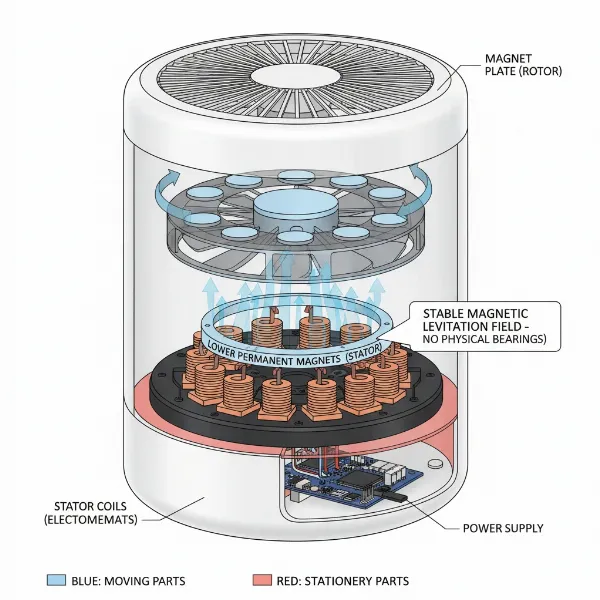 Diagram of a magnetic levitation fan showing rotor suspended by magnetic fields
The Unrivaled Advantages of Magnetic Levitation Electric Fans
The adoption of magnetic levitation technology brings a cascade of benefits, making these electric fans a superior choice for a multitude of applications.
Extended Lifespan and Durability
|
Our Picks for the Best Electric fan in 2026
As an Amazon Associate I earn from qualifying purchases.
|
||
| Num | Product | Action |
|---|---|---|
| 1 | Dreo Tower Fan for Bedroom, 25ft/s Velocity Quiet Floor Fan, 90° Oscillating Fans for Indoors with 4 Speeds, 4 Modes, 8H Timer, Standing Fans, Bladeless Fan, Black, Nomad One (DR-HTF007) |

|
| 2 | XPOWER FC-100S Multipurpose 11 Pro Air Circulator Utility Fan with Oscillating Feature |
|
| 3 | Dreo Fan for Bedroom, 120° Oscillating Standing Fans, Quiet Floor Fan with DC Motor, 100ft Pedestal Fans for Room, 9 Speeds, 4 modes, 20dB, 120° Manual Vertical, 37-42" Adjustable Height, 9H Timer |
|
| 4 | Amazon Basics 16" Pedestal Fan with Remote, Floor Fan, Standing Fan for Bedroom, Living Room, Office, with 3 Speeds, 3 Modes, Timer, Dual-Layered Blades, Adjustable Height, Tilt Head, 60W, Black |
|
| 5 | Dreo Fan for Bedroom, 120° Oscillating Standing Fan, Quiet Floor Fan with DC Motor, Pedestal Fan for Room, 9 Speeds, 4 modes, 20dB, 120° Manual Vertical, 37-42" Adjustable Height, 9H Timer, Black |
|
| 6 | Lasko 2520 Oscillating Stand Fan,White 16 Inch |
|
| 7 | LEVOIT Tower Fan for Bedroom, 25ft/s Velocity Standing Fan with 28dB Quiet for Sleep, Remoter, 12H Timer, 5 Speeds, 4 Modes, 90° Oscillation for Home, Office, Indoor, Bladeless 36 inch, White |
|
| 8 | Amazon Basics Air Circulator Fan, Desk Fan for Bedroom, Home and Office, With 90-Degree Tilt Head, 3 Speed Settings, Lightweight (3 LBS), 35 Watts, Black, 11.1"W x 6.3"D x 10.9"H |
|
| 9 | 10" Modern Standing Fan for Bedroom, Sleek Oscillating Pedestal Fan, 3-Speed & Height Adjustable Compact Floor Fan for Home Office & Dorm |
|
| 10 | Viniper Portable Rechargeable Fan, Small Desk Fan : 3 Speeds & about 8-24 Hours Longer Working, 180 Rotation, Portable Desktop Fan Small but Mighty, Strong Wind (White, Light Black Blade)6.2 Inch |
|
One of the most compelling advantages of MagLev fans is their remarkably extended operational lifespan. Traditional fans typically last between 5,000 to 40,000 hours, necessitating more frequent replacements. In stark contrast, magnetic levitation fans can achieve over 200,000 hours of use. This monumental increase in durability is a direct result of eliminating mechanical friction and wear, making them a wise long-term investment. “Magnetic levitation fans are a groundbreaking solution because they bypass the Achilles’ heel of traditional fans – friction,” notes a leading engineer in cooling solutions. “This fundamentally changes the lifespan equation.”
Whisper-Quiet Operation
For many users, fan noise is a constant irritant. MagLev fans address this by operating with astonishing quietness. With no physical contact between moving parts, the mechanical noise associated with bearings is virtually eliminated. These fans can operate at noise levels as low as 10dB, which is significantly quieter than conventional models that typically run at 24dB or even 35-50dB for some residential fans. This makes them ideal for environments where silence is paramount, such as home theaters, libraries, or recording studios, creating a more peaceful and productive atmosphere.
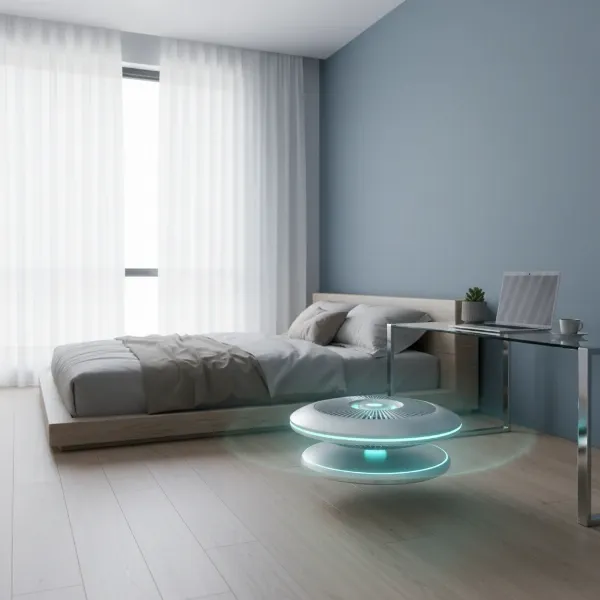 Silent magnetic levitation fan cooling a modern, peaceful home office
Superior Energy Efficiency
Energy consumption is a critical consideration in today’s world. Magnetic levitation technology offers a notable improvement in energy efficiency, demonstrating up to a 30% reduction in energy consumption compared to traditional fans. This efficiency stems from the minimal resistance encountered by the rotor as it spins, requiring less power to maintain high speeds and airflow. For consumers and businesses alike, this translates directly into lower electricity bills and a smaller carbon footprint, aligning with the growing demand for sustainable technologies.
Consistent Performance and Reliability
The absence of mechanical friction not only extends lifespan and reduces noise but also ensures highly stable and consistent performance. MagLev fans exhibit significantly less vibration and can maintain optimal performance even at higher speeds. They also tend to offer better static pressure, which is crucial for pushing air through restrictive environments like dense filters or radiators. Furthermore, the elimination of complex gearboxes and the need for oil lubrication drastically reduces maintenance requirements, ensuring higher reliability and less downtime.
Magnetic Levitation Electric Fans in Action: Current and Future Applications
The benefits of magnetic levitation technology are already transforming various sectors, with immense potential for future expansion.
Revolutionizing Personal Computing and Electronics
In the world of high-performance computing, keeping components cool without generating excessive noise is a constant challenge. MagLev fans are a game-changer for PC cooling, allowing for higher rotation speeds and greater airflow with significantly subdued sound levels. Brands like Corsair have embraced this technology in their ML series fans, providing PC enthusiasts and professionals with more efficient and quieter cooling solutions for their powerful systems. This also extends to other sensitive electronics where heat management is critical.
Advancing HVAC and Data Center Cooling
Magnetic levitation units are becoming a significant trend in HVAC (Heating, Ventilation, and Air Conditioning) and data center sectors. Here, the technology is applied not just to simple fans but to compressors and chillers, replacing mechanical bearings with magnetic fields. This innovation leads to improved efficiency, reliability, and substantial energy savings in large installations. Pedro Fernandes, commercial director of Trane Portugal, emphasizes that “the drive for greater energy efficiency, sustainability, and reliability is propelling this technological advancement” in these critical infrastructures. MagLev turbo blowers, for instance, are replacing traditional blowers in industrial applications, showcasing their ability to handle demanding airflow requirements with higher efficiency and lower noise.
Beyond the Fan: Broader Industry Impact
The implications of magnetic levitation extend far beyond traditional fan applications. The underlying principle of frictionless movement has universal potential across industries. Experts predict that MagLev innovation could be integrated into various devices, including cars, power tools, and general office equipment, making them more efficient, quiet, and productive. This cross-industry applicability underscores the transformative power of MagLev technology as a cornerstone of future engineering.
The Road Ahead: Challenges and Considerations for Magnetic Levitation Fans
While the promise of magnetic levitation electric fans is considerable, like any emerging technology, they come with certain challenges that are being addressed as the field matures.
Initial Cost vs. Long-Term Value
Currently, the initial investment for magnetic levitation fans tends to be higher than that of their traditional counterparts. For instance, while a conventional fan might cost between $15 and $35, a MagLev fan could range from $70 to $120. This higher upfront cost can be a barrier for some consumers or businesses, despite the long-term savings in energy and maintenance. However, as production scales up and research leads to more affordable materials, costs are expected to decrease, making them more accessible.
Technological Complexity
The advanced nature of magnetic levitation technology can sometimes present challenges in terms of installation and troubleshooting. While their robust design reduces the likelihood of mechanical failures, issues such as improper rotor alignment or insufficient magnetic field strength can lead to vibrations or unstable operation, requiring specialized knowledge to diagnose and rectify. Continued development aims to simplify these systems for broader user adoption.
Airflow Noise: A Persistent Factor
It’s important to distinguish between motor noise and airflow noise. While MagLev technology brilliantly eliminates the noise generated by mechanical bearings, the movement of air itself will always create a certain level of sound, especially at higher speeds. As one expert succinctly puts it, “The faster fan blades spin, the more air you’re pushing, and you’re always going to create more noise from the air.” This means that while magnetic levitation fans are exceptionally quiet in terms of mechanical operation, they are still subject to the physics of air displacement.
Buying Guide: Is a Magnetic Levitation Electric Fan Right for You?
Considering the benefits and challenges, deciding if a magnetic levitation electric fan is the right choice depends on your specific needs and priorities.
What’s Your Budget?
While the initial cost is higher, evaluate the long-term savings from reduced energy consumption and extended lifespan. If you’re planning for a durable, energy-efficient solution over many years, the investment in a MagLev fan can be justified.
What Are Your Cooling Needs and Environment?
If quiet operation is a top priority, such as in a bedroom, office, home theater, or data center, a MagLev fan offers unparalleled acoustic performance. For high-performance systems or environments requiring consistent, powerful airflow, their sustained efficiency is a significant advantage.
Which Features Do You Prioritize?
If you value longevity, low maintenance, and energy savings, MagLev fans deliver exceptional value. Many models also offer advanced control options, allowing you to tailor cooling performance to your specific requirements.
| Feature | Magnetic Levitation Fans | Traditional Fans |
|---|---|---|
| Lifespan | 200,000+ hours | 5,000 – 40,000 hours |
| Noise Level | As low as 10 dB | 24 – 50+ dB (can exceed 90+ dB for industrial) |
| Energy Efficiency | Up to 30% reduction | Higher energy consumption (due to friction) |
| Friction | Virtually none | Significant |
| Maintenance | Minimal (no lubrication, less wear) | Regular (cleaning, oiling, bearing replacement) |
| Initial Cost | Higher ($70-$120) | Lower ($15-$35) |
| Vibration | Very low, stable operation | Can be noticeable, unstable at high speeds |
Conclusion
Magnetic levitation electric fans represent a significant leap forward in cooling technology. By eliminating mechanical friction, they offer an impressive suite of benefits, including vastly extended lifespans, remarkably quiet operation, and substantial energy savings. While the initial investment might be higher and the technology more complex, the long-term advantages in durability, performance, and reduced environmental impact make them a compelling solution for the future of cooling. As research and development continue to advance, we can expect MagLev fans to become an increasingly common and essential component in our everyday lives, ushering in an era of more sustainable and serene cooling. Are you ready to embrace the quiet revolution of magnetic levitation electric fans?
Frequently Asked Questions
What is the primary benefit of a magnetic levitation electric fan?
The primary benefit of a magnetic levitation electric fan is its ability to operate without physical contact between moving parts, eliminating friction. This results in an exceptionally long lifespan, whisper-quiet operation, and significantly improved energy efficiency compared to traditional fans.
Are magnetic levitation fans worth the higher cost?
For many users, magnetic levitation fans are worth the higher initial investment due to their long-term benefits. They offer substantial savings on electricity bills, require minimal maintenance, and last considerably longer, reducing the frequency of replacements. The superior performance in terms of noise and stability also adds significant value.
Can magnetic levitation fans be used in any application?
Magnetic levitation fans are highly versatile and are increasingly being adopted across various applications, from personal computers and high-performance electronics to large-scale HVAC systems and data centers. Their benefits are particularly pronounced in environments where quiet operation, energy efficiency, and reliability are critical.
How do magnetic levitation fans contribute to sustainability?
Magnetic levitation fans contribute to sustainability by significantly reducing energy consumption, thanks to their frictionless operation. This lowers greenhouse gas emissions associated with electricity generation. Additionally, their extended lifespan means less material waste from frequent fan replacements, supporting a more environmentally conscious approach to cooling.